
How to Start Crypto Mining: Hardware, Software, Costs & Profit
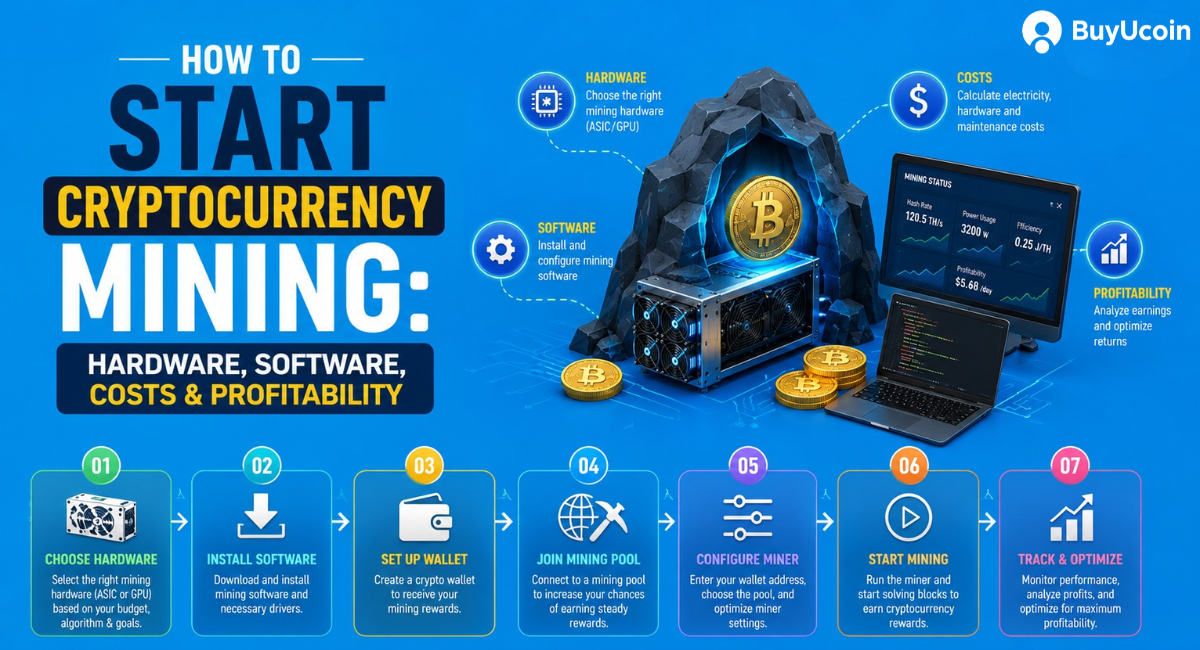
Cryptocurrency mining is more than running a computer and earning coins. To start mining, you need to understand the right blockchain, mining hardware, software, electricity cost, mining pools, rewards, risks, and whether the economics actually make sense for you.
Mining Goal → Choose a PoW Network → Select Hardware → Install Software → Join a Pool → Calculate Costs → Monitor Profitability
If you are completely new to the concept, first read our What Is Cryptocurrency? guide and then explore our detailed What Is Cryptocurrency Mining? guide before moving into this practical setup.
How Do You Start Cryptocurrency Mining?
Starting cryptocurrency mining involves much more than buying a mining machine.
A practical process looks like this:
Choose a Mineable Cryptocurrency → Check Mining Algorithm → Select Hardware → Calculate Electricity Cost → Install Mining Software → Configure Wallet → Join a Mining Pool → Start Mining → Track Revenue & Costs
The first question should therefore not be:
“Which cryptocurrency mining machine should I buy?”
It should be:
“Which Proof-of-Work network can I realistically mine profitably with my available hardware and electricity?”
Bitcoin, for example, uses Proof-of-Work, while Ethereum Mainnet no longer uses mining after it transitions to Proof-of-Stake.
Which Cryptocurrencies Can You Mine?
Not every cryptocurrency can be mined.
Traditional mining is associated with Proof-of-Work (PoW) networks. Other networks use different consensus mechanisms, such as Proof-of-Stake.
Network Type | Mining | Typical Participant |
Proof-of-Work | Yes | Miner |
Proof-of-Stake | No traditional mining | Validator |
Other consensus models | Depends on protocol | Varies |
What about Bitcoin?
Bitcoin is the most prominent example of a cryptocurrency secured through Proof-of-Work mining.
Miners compete to produce valid blocks, and successful blocks become part of Bitcoin's blockchain after network validation. Bitcoin's developer documentation describes both solo and pooled mining and explains how mining hardware searches for a valid hash below the network target.
What about Ethereum?
Ethereum is not mineable today.
The network switched from Proof-of-Work to Proof-of-Stake on September 15, 2022. Validators now perform the consensus role previously associated with miners.
So an important rule is:
Always check the cryptocurrency's current consensus mechanism before buying mining hardware.
What Hardware Do You Need for Cryptocurrency Mining?
The hardware depends on the cryptocurrency and its mining algorithm.
The main categories are:
CPU Mining
CPU mining uses your computer's processor.
It is technically possible for certain networks, but CPU mining is generally not competitive for major networks such as Bitcoin.
GPU Mining
GPU mining uses graphics processing units to perform large numbers of parallel calculations.
This is why searches such as:
GPU cryptocurrency mining rig
GPU cryptocurrency mining rigs
cryptocurrency mining machine
appear frequently around mining.
A GPU rig may contain multiple graphics cards, a suitable motherboard, power supply, cooling system, storage and other components.
ASIC Mining
ASIC means Application-Specific Integrated Circuit.
An ASIC is hardware designed for a particular computational task or mining algorithm.
Bitcoin mining today relies heavily on specialized ASIC hardware rather than ordinary desktop computers. Bitcoin's developer documentation describes mining hardware performing repeated hash calculations against the network target.
What Is a Cryptocurrency Mining Rig?
A cryptocurrency mining rig is a computer system assembled specifically for mining.
A typical GPU mining rig may contain:
Multiple GPUs
Motherboard
CPU
RAM
Storage
Power supply
Risers, where required
Cooling fans
Mining software
Internet connection
Wallet/payout address
Think of it as a computer optimized for continuous computational work rather than normal activities such as gaming, browsing or office work.
Simple Example
A normal PC might be designed for:
Gaming + Work + Entertainment
A mining rig is designed primarily for:
Continuous Hashing → Proof-of-Work Computation → Mining Rewards
How Much Does a Cryptocurrency Mining Machine Cost?
There is no single cryptocurrency mining machine price.
The cost depends on:
Mining algorithm
ASIC vs GPU
Hashrate
Power efficiency
Number of GPUs
Brand and model
New vs used hardware
Power supply
Cooling
Local electricity infrastructure
A complete setup can cost substantially more than the headline price of the machine itself.
Your actual starting budget may include:
Expense | Example |
Mining machine/GPUs | Hardware investment |
Power supply | Required for continuous operation |
Cooling | Fans/ventilation/air conditioning where necessary |
Internet | Stable connectivity |
Storage/CPU/RAM | Required for the system |
Electricity | Recurring operating cost |
Maintenance | Repairs and replacement |
Pool fees | If using a mining pool |
Therefore, cryptocurrency mining machine price should never be evaluated in isolation.
The more useful calculation is:
Hardware Cost + Setup Cost + Expected Operating Cost
GPU vs ASIC Mining: Which Is Better?
There is no universal winner.
GPU Mining | ASIC Mining |
More flexible for compatible algorithms | Designed for specific algorithms |
Can potentially be repurposed | Usually highly specialized |
Modular setup | Purpose-built hardware |
Often easier to experiment with | Typically focused on efficiency for its algorithm |
Performance depends on GPUs and configuration | Performance depends on ASIC model |
For Bitcoin
ASIC mining is the relevant hardware category for serious Bitcoin mining because of the scale of competition.
For GPU-Mineable Networks
A GPU setup may make more sense if the specific network and algorithm support it and the economics work.
Choose the network first, then choose the hardware.
Doing it in the opposite order is one of the easiest ways to make a costly mistake.
What Cryptocurrency Mining Software Do You Need?
Mining hardware needs software to communicate with the blockchain network or mining pool and coordinate the mining process.
Depending on the network and hardware, mining software may handle tasks such as:
Connecting to a mining pool
Receiving work
Sending completed shares
Monitoring hashrate
Monitoring temperature
Reporting rejected shares
Managing mining settings
Sending payout information
Bitcoin's developer documentation describes mining software constructing block information and communicating with mining hardware, including ASICs.
What Should You Check Before Installing Mining Software?
Never download mining software from an unknown website simply because it promises higher returns.
Check:
Official project documentation
Software reputation
Supported operating system
Supported hardware
Mining algorithm
Pool compatibility
Security history
Community feedback
A fake cryptocurrency mining software download can be more dangerous than an expensive electricity bill because malicious software may compromise your computer or credentials.
How Do You Set Up a Cryptocurrency Mining Rig?
Once you have selected a mineable network and compatible hardware, the general setup looks like this:
Step 1: Choose the Cryptocurrency
Confirm that it uses Proof-of-Work.
Step 2: Understand Its Mining Algorithm
Your hardware must support the algorithm.
Step 3: Calculate Electricity Cost
Find your actual electricity price per kWh.
Step 4: Select Hardware
Choose hardware based on hashrate and power efficiency rather than appearance or price alone.
Step 5: Install Mining Software
Use trusted software compatible with the selected network.
Step 6: Create a Wallet or Payout Destination
You need a suitable destination for your mining rewards.
Step 7: Choose Solo or Pool Mining
Understand the difference before starting.
Step 8: Configure the Miner
Set the pool, wallet address and relevant mining parameters.
Step 9: Monitor Performance
Track:
Hashrate
Temperature
Power consumption
Accepted shares
Rejected shares
Downtime
Revenue
Step 10: Recalculate Profitability Regularly
Mining economics change.
A setup that looks profitable today can become unprofitable later.
What Is a Cryptocurrency Mining Pool?
A mining pool combines the computing power of multiple miners.
Instead of one small miner waiting for a potentially long time to discover a block alone, the pool coordinates many participants and distributes payouts according to its rules and the miner's contributed work.
The simplified model is:
Many Miners → Combined Hashrate → More Frequent Block Discovery → Shared Rewards
Bitcoin's developer documentation distinguishes solo mining from pooled mining and explains that pool rewards are distributed according to contributed hashing work.
Solo Mining vs Pool Mining
Solo Mining | Pool Mining |
Mine independently | Combine computing power |
Higher payout variance | Lower payout variance |
Entire reward if successful | Reward shared |
Requires significant competitive power | More accessible to smaller miners |
For a beginner with limited computing power, understanding mining pools is essential before assuming solo mining will produce regular income.
How Much Electricity Does Cryptocurrency Mining Use?
This is one of the most important questions before starting.
Mining hardware continuously performs computational work, which consumes electricity.
Your electricity cost depends on:
Power Consumption × Operating Hours × Electricity Rate
Example
Suppose a mining setup consumes:
2,000 watts = 2 kW
and operates for:
24 hours/day
Daily electricity consumption:
2 kW × 24 = 48 kWh
If electricity costs:
₹8/kWh
Daily electricity cost:
48 × ₹8 = ₹384
Approximate 30-day electricity cost:
₹384 × 30 = ₹11,520
And that's only electricity.
You still need to consider:
Hardware depreciation
Cooling
Maintenance
Internet
Pool fees
Repairs
This is why electricity is often one of the most important variables in mining economics.
How Much Does It Cost to Mine Cryptocurrency?
The total cost can be divided into two categories.
Initial Costs
Mining machine
GPUs/ASIC
Motherboard
Power supply
RAM/storage
Cooling
Electrical setup
Recurring Costs
Electricity
Internet
Maintenance
Repairs
Pool fees
Cooling
Hardware replacement
So a more realistic equation is:
Total Mining Cost = Hardware + Setup + Electricity + Maintenance + Other Operating Costs
A person who looks only at the cryptocurrency mining machine price may underestimate the actual cost of running the operation.
How Is Crypto Mining Profitability Calculated?
The simplest model is:
Mining Revenue − Operating Costs = Potential Operating Profit
But mining revenue itself depends on several variables.
Revenue can depend on:
Cryptocurrency price
Block reward
Transaction fees
Your hashrate
Network hashrate
Mining difficulty
Pool payout structure
Costs can include:
Electricity
Pool fees
Hardware depreciation
Cooling
Maintenance
Repairs
Example
Suppose a mining setup generates approximately:
₹20,000 monthly revenue
Costs:
Electricity: ₹12,000
Pool fees: ₹1,000
Cooling/maintenance: ₹2,000
Potential operating surplus:
₹20,000 − ₹15,000 = ₹5,000
But that ₹5,000 is not necessarily your final investment return.
You still need to account for the original hardware investment and its depreciation.
Is Cryptocurrency Mining Profitable in 2026?
It can be, but profitability is highly dependent on the specific network, hardware and electricity price.
A miner should evaluate:
Hardware hashrate
Hardware power consumption
Electricity price
Current network difficulty
Expected reward
Cryptocurrency price
Pool fees
Cooling costs
Hardware lifespan
Tax implications
The key formula
Revenue − Electricity − Operating Costs − Hardware Cost/Depreciation = Economic Return
If someone tells you:
“This mining machine makes ₹X every month guaranteed.”
be skeptical.
Mining rewards and cryptocurrency prices are variable, so guaranteed returns are not a realistic way to evaluate a mining business.
Can You Mine Cryptocurrency With a Normal PC?
Technically, some networks may be mineable using consumer hardware. That does not mean the setup will be profitable.
For Bitcoin specifically, the competitive environment has moved toward specialized mining hardware.
A normal laptop or desktop may consume electricity while producing an amount of mining revenue that is too small to justify:
Electricity
Heat
Hardware wear
Opportunity cost
Example
Suppose your PC generates:
₹300 mining revenue
but consumes:
₹500 electricity
You have already lost:
₹200
before considering hardware depreciation.
Therefore:
Possible to mine ≠ Profitable to mine
What Is Cryptocurrency Cloud Mining?
Cloud mining allows users to access mining capacity without personally operating all of the physical hardware.
The basic concept is:
Provider's Hardware → Mining Capacity → User Contract/Share → Potential Payout
This can sound attractive because you don't need to build a mining rig yourself.
But the user takes on another type of risk: counterparty risk.
Before paying for any cryptocurrency mining cloud service, check:
Who operates the hardware?
Where is the hardware located?
What are the contract terms?
What fees apply?
How are payouts calculated?
Can the contract be terminated?
Is the return guaranteed?
Can the provider prove the mining operation exists?
Be especially careful with:
Guaranteed daily mining income
Risk-free cloud mining
Double your money through mining
Mining is an uncertain economic activity. A guaranteed-return promise should be treated as a major warning sign.
Is Cryptocurrency Mining Legal in India?
This question needs to be separated into mining activity, tax treatment and broader digital-asset regulation.
India's tax framework currently recognizes Virtual Digital Assets (VDAs), and the Income Tax Department states that income from transfer of VDAs is taxed under Section 115BBH at 30%, subject to the statutory provisions.
However, that does not mean that every aspect of running a cryptocurrency mining operation has one simple “legal/illegal” answer.
If mining is being conducted as a serious business, you should consider:
Tax treatment
Business structure
Electricity usage
Accounting
VDA reporting
Applicable local requirements
Record keeping
For tax purposes, don't assume that receiving mined cryptocurrency and later transferring/selling it are automatically treated as one identical event. The applicable facts and tax provisions matter.
The Income Tax Department's current VDA guidance also requires transaction-wise reporting for transfers of VDAs in the relevant ITR schedule.
How Can Cryptocurrency Mining Affect Taxes in India?
This is an area where miners should maintain detailed records.
Keep track of:
Date rewards were received
Quantity received
Asset received
Relevant valuation records
Mining-related transactions
Later transfers/sales
Transaction statements
Wallet records
Applicable TDS records
Section 194S provides a 1% TDS framework for qualifying payments for transfer of VDAs, subject to its conditions and thresholds.
The important distinction is:
Mining activity → Receiving digital assets → Later transfer/sale
These stages should not automatically be treated as one transaction for tax analysis.
If mining is generating meaningful or regular income, a qualified tax professional should review the specific structure.
Is Cryptocurrency Mining Worth It for Beginners?
Before spending money on a mining machine, answer these questions:
Question | Why It Matters |
Is the asset mineable? | Not every cryptocurrency uses PoW |
What hardware is required? | Determines initial investment |
What is the hashrate? | Determines computational contribution |
How much power does it consume? | Determines recurring cost |
What is my electricity rate? | Directly affects profitability |
Is a pool needed? | Affects payout structure |
What is the current difficulty? | Affects expected rewards |
What happens if price falls? | Determines downside |
What is the hardware lifespan? | Determines long-term economics |
What are the tax obligations? | Affects net returns |
If you cannot answer these questions, research first and buy hardware later.
Pros and Cons of Cryptocurrency Mining
Pros
Supports Proof-of-Work blockchain security.
Helps process and add transactions to blocks.
Can generate block rewards and transaction fees.
Gives participants a way to contribute computing resources to a decentralized network.
Can become economically viable under favourable conditions.
Cons
High electricity consumption on energy-intensive networks.
Hardware can require significant upfront investment.
Profitability changes with market conditions.
Mining difficulty can change.
Hardware can become obsolete.
Cooling and maintenance increase operating costs.
Mining has technical and operational complexity.
Cloud-mining services introduce counterparty risk.
What Should You Check Before Buying a Cryptocurrency Mining Machine?
Don't buy based only on the machine's advertised hashrate.
Compare:
1. Hashrate
How much computational work can the machine perform?
2. Power Consumption
How many watts does it use?
3. Efficiency
How much power does it require for its computational output?
4. Algorithm Compatibility
Does it actually support the cryptocurrency you want to mine?
5. Hardware Price
How much capital will you need upfront?
6. Cooling Requirements
Can your location safely dissipate the heat?
7. Noise
Some mining hardware can be very loud.
8. Warranty and Repairs
What happens if the machine fails?
9. Resale Value
Can the hardware retain value if mining economics change?
10. Expected Payback
How long could it take to recover the hardware investment under realistic assumptions?
What Is the Difference Between Mining and Buying Cryptocurrency?
Mining and buying are completely different ways to obtain digital assets.
Buying Crypto | Mining Crypto |
Purchase an asset with INR or another currency | Contribute computing resources to a PoW network |
No mining hardware required | Hardware may be required |
Simple entry process | Technical setup required |
Main exposure is market price | Exposure includes market + operating costs |
Suitable for straightforward market access | More complex and operational |
If your primary goal is simply to gain exposure to digital assets, buying may be much simpler than setting up a mining operation.
For a broader comparison of crypto trading and investment decisions, you can also read BuyUcoin's Crypto Trading or Crypto Investment? guide.
How Do Mining Rewards Actually Reach You?
The simplified process is:
Mining Work → Valid Share/Block → Pool or Network Records Contribution → Reward Calculation → Payout
In solo mining, a successful miner can receive the block reward and transaction fees associated with the block.
In pooled mining, the pool receives the reward and distributes payouts according to its payout system and the miner's contributed work.
This is why joining a pool does not mean you receive the entire block reward.
What Are the Biggest Cryptocurrency Mining Risks?
Market Risk
The cryptocurrency price can fall while your electricity bill remains unchanged.
Difficulty Risk
More competition can change the amount of work required to earn rewards.
Hardware Risk
Mining equipment can fail or become outdated.
Electricity Risk
Higher electricity prices can turn profitable mining into a loss.
Security Risk
Malicious mining software can compromise your system.
Scam Risk
Fake mining websites and cloud-mining schemes can promise unrealistic returns.
Regulatory and Tax Risk
Applicable Indian tax and reporting rules can affect your net outcome.
A mining business therefore has technology risk + market risk + operating risk + regulatory risk.
Frequently Asked Questions About Cryptocurrency Mining
What is cryptocurrency mining?
Cryptocurrency mining is the process used by Proof-of-Work networks to perform computational work, validate transactions, produce valid blocks, and help secure the blockchain. If you want to understand the concept in more detail, see BuyUcoin’s What Is Cryptocurrency Mining? guide before exploring the practical steps involved in setting up a mining operation.
What is a cryptocurrency mining machine?
It is specialized hardware designed to perform the calculations required by a particular Proof-of-Work mining algorithm.
How much does a cryptocurrency mining machine cost?
There is no fixed price. The cost depends on the hardware type, hashrate, power efficiency, model and market conditions.
What is a GPU cryptocurrency mining rig?
It is a computer system containing one or more GPUs and supporting components configured to perform mining calculations for compatible Proof-of-Work networks.
What cryptocurrency mining software do I need?
The software depends on the cryptocurrency, mining algorithm, hardware and whether you are mining independently or through a pool.
Can I mine cryptocurrency with my laptop?
Some networks may technically allow consumer hardware, but Bitcoin mining with ordinary laptops is generally not economically competitive.
Is cryptocurrency mining profitable?
It can be, but profitability depends on electricity cost, hardware efficiency, cryptocurrency price, network difficulty, rewards and operating expenses.
What is cryptocurrency mining cloud?
Cloud mining allows users to access mining capacity operated by another provider instead of running all the physical hardware themselves. It introduces additional counterparty and contract risks.
Can you still mine Bitcoin in 2026?
Yes. Bitcoin continues to use Proof-of-Work, but competitive Bitcoin mining requires specialized hardware and careful attention to electricity and operating costs.
Is Ethereum mining still possible?
No. Ethereum switched from Proof-of-Work to Proof-of-Stake in September 2022, and mining is no longer used on Ethereum Mainnet.
Is cryptocurrency mining legal in India?
Mining should be considered alongside India's current tax and digital-asset framework. The exact legal, tax and business implications depend on the activity and circumstances, so miners should verify current requirements and seek professional advice for commercial operations.
Final Thoughts: Should You Start Cryptocurrency Mining?
Cryptocurrency mining can look simple from the outside:
Buy Machine → Turn It On → Earn Crypto
In reality, the process is:
Choose PoW Network → Select Algorithm → Buy Compatible Hardware → Calculate Electricity → Install Software → Join Pool → Mine → Track Revenue → Track Costs → Recalculate Profitability
The most important lesson is that mining rewards are not the same as profit.
A ₹2 lakh mining machine is not automatically a good investment simply because it can generate cryptocurrency. Electricity, network difficulty, hardware efficiency, maintenance, cryptocurrency price and taxes can completely change the economics.
If your goal is to understand digital assets before committing money, start with education rather than equipment. BuyUcoin's What Is Cryptocurrency? guide can help establish the basics, while our What Is Cryptocurrency Mining? guide explains the underlying Proof-of-Work mechanism in greater depth.
Explore Digital Assets with BuyUcoin
If after researching mining you decide that buying and learning about digital assets is more practical for your goals, you can explore the market through BuyUcoin.
Create a BuyUcoin account and complete the required KYC.
Explore supported digital assets before making a decision.
Check live cryptocurrency prices and understand the asset before buying.
Start with an amount you can afford to lose rather than treating crypto as guaranteed income.
Continue learning through BuyUcoin's educational resources before moving into advanced activities such as trading or mining.
Learn first → Compare the economics → Understand the risks → Make an informed decision.
| Start your crypto journey With BuyuUcoin App |
Disclaimer: This article is for educational purposes only and does not constitute financial, investment, tax, or legal advice. Mining involves market, technical, financial, and regulatory risks, and applicable rules may change.