
What Is Cryptocurrency Mining?
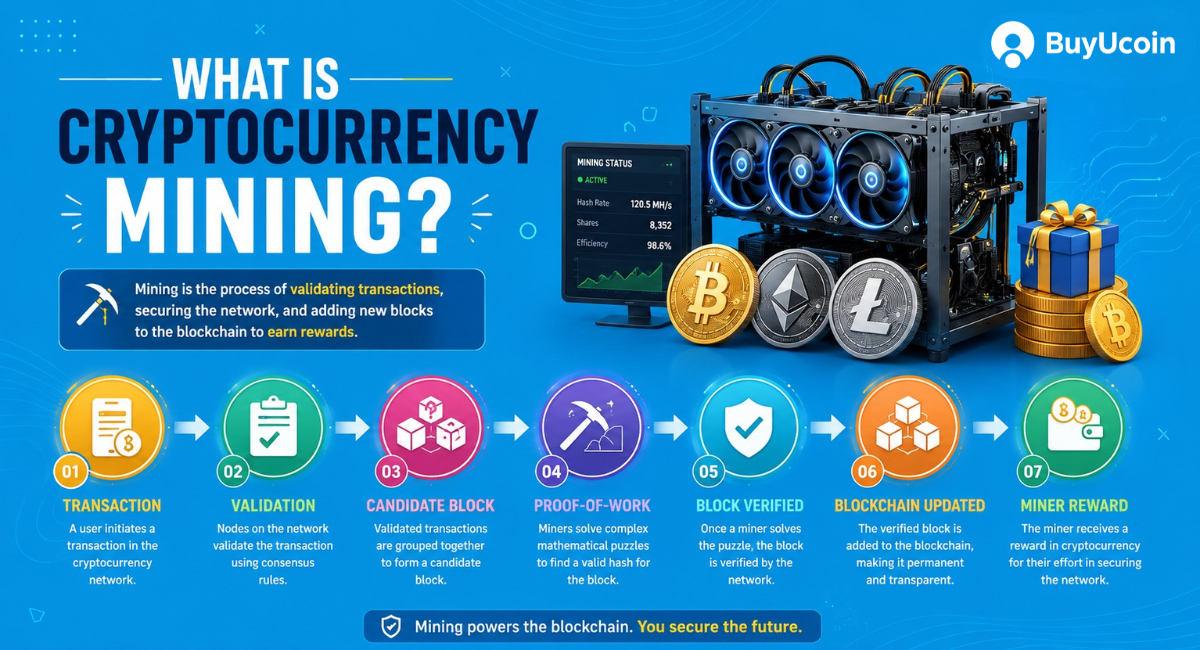
Transaction → Validation → Candidate Block → Proof-of-Work → Block Verified → Blockchain Updated → Miner Reward
Cryptocurrency mining is the process used by Proof-of-Work blockchain networks to validate transactions, add new blocks to the blockchain, and maintain network security. Miners use computing power to solve a cryptographic problem, and successful miners can receive block rewards and transaction fees.
But mining is not simply “using a computer to create coins.” It is a combination of transaction processing, Proof-of-Work, competition, network security, and reward distribution.
How Does Cryptocurrency Mining Work?
The easiest way to understand mining is to follow what happens when someone sends a transaction.
The basic process
Transaction Created → Transactions Broadcast → Miner Builds a Block → Proof-of-Work → Block Verified → Block Added → Miner Receives Reward
For example, imagine Rahul sends 0.01 BTC to Priya.
Rahul creates and signs the transaction.
The transaction is broadcast to the Bitcoin network.
Miners collect valid pending transactions.
A miner builds a candidate block.
Mining hardware repeatedly calculates hashes to find a valid Proof-of-Work.
A miner finds a valid result and broadcasts the block.
Other network participants verify the block.
If it follows Bitcoin's consensus rules, the block becomes part of the blockchain.
The successful miner can receive the block subsidy and eligible transaction fees.
So, the miner isn't deciding whether Rahul is “allowed” to send Bitcoin. The network's rules determine whether the transaction and block are valid.
Why Is Mining Necessary for Some Cryptocurrencies?
Mining serves several important functions on Proof-of-Work networks.
Function | Why It Matters |
Transaction processing | Helps include valid transactions in blocks |
Consensus | Helps distributed participants agree on the blockchain's history |
Security | Makes rewriting historical blocks computationally expensive |
Block production | Provides a mechanism for adding new blocks |
Issuance | On networks such as Bitcoin, block subsidies introduce new coins according to protocol rules |
Bitcoin's own documentation describes mining as a distributed consensus system that helps confirm transactions, maintain chronological order and protect the network.
A simple real-world analogy:
Imagine thousands of people maintaining copies of the same accounting book.
Instead of trusting one accountant, the network requires participants to complete a difficult computational task before a new page can be accepted.
The work makes it expensive to manipulate the record while allowing the network to operate without a central authority.
That is the basic idea behind Proof-of-Work
What Is Proof-of-Work in Crypto Mining?
Proof-of-Work (PoW) is a consensus mechanism in which miners compete to find a valid cryptographic result.
A simplified version looks like this:
Block Data + Changing Number (Nonce) → Hash → Check Against Target
If the resulting hash does not satisfy the network's target, the miner changes the input and tries again.
No shortcut reliably tells a miner which nonce will work. The hardware performs enormous numbers of attempts until one produces a valid result.
Bitcoin's developer documentation explains that the block header is repeatedly hashed and the resulting value must satisfy the network's difficulty target.
Why does this matter?
Because anyone can verify the winning result relatively quickly, while finding it required substantial computational work.
That creates an important asymmetry:
Hard to find → Easy to verify
What Exactly Does a Bitcoin Miner Do?
A Bitcoin miner performs much more than simply “solving math.”
A simplified mining operation looks like this:
Receive pending transactions
↓
Select valid transactions
↓
Construct a candidate block
↓
Create the block header
↓
Run repeated SHA-256 calculations
↓
Search for a valid Proof-of-Work
↓
Broadcast the block
↓
Network validates it
↓
Receive reward if the block is accepted
Bitcoin's block structure includes a previous-block hash, transaction information and other header data that becomes part of the Proof-of-Work calculation.
How Do Miners Earn Cryptocurrency?
A miner's potential revenue can come from two primary sources:
1. Block Subsidy
Newly issued Bitcoin can form part of the reward for a successfully mined block.
2. Transaction Fees
Transactions included in a block can pay fees that go to the miner who successfully produces that block.
So:
Block Reward = Block Subsidy + Transaction Fees
However:
Revenue ≠ Profit
A miner must still account for electricity, hardware, cooling, maintenance, infrastructure and other operating costs.
Can Every Cryptocurrency Be Mined?
No.
This is one of the most important things beginners should understand.
Mining is primarily associated with Proof-of-Work networks.
Other networks use different consensus mechanisms.
Consensus Mechanism | Traditional Mining? | Main Participant |
Proof-of-Work | Yes | Miners |
Proof-of-Stake | No | Validators |
Other mechanisms | Depends on network | Varies |
What about Ethereum?
Ethereum is a particularly important example.
Ethereum used to use Proof-of-Work, but The Merge in September 2022 moved the network to Proof-of-Stake. Ethereum mining is therefore no longer part of the current Ethereum Mainnet consensus process. Validators now perform the block-production and consensus role through staking.
So if someone says:
“I want to mine Ethereum today.”
That is outdated information.
You cannot mine Ethereum Mainnet today; Ethereum uses Proof-of-Stake.
What Is the Difference Between Mining and Staking?
The two are often confused because both can help secure blockchain networks and provide rewards, but they work differently.
Mining | Staking |
Usually associated with Proof-of-Work | Used by Proof-of-Stake networks |
Requires computational work | Requires locking/staking assets |
Uses specialized hardware on major PoW networks | Uses validator infrastructure or staking services |
Electricity consumption can be significant | Generally much less energy-intensive |
Participants are miners | Participants are validators/stakers |
Ethereum's transition from Proof-of-Work to Proof-of-Stake reduced its energy consumption by approximately 99.95%, according to Ethereum's official documentation.
What Hardware Do You Need for Crypto Mining?
The hardware depends heavily on the blockchain being mined.
CPU Mining
Uses a computer's central processing unit.
It can work for some networks, but it is generally not competitive for Bitcoin mining.
GPU Mining
Uses graphics processing units.
GPUs can perform highly parallel calculations and have historically been useful for several Proof-of-Work networks.
ASIC Mining
Application-Specific Integrated Circuits (ASICs) are specialized machines designed for particular mining algorithms.
Bitcoin mining is now highly specialized, with dedicated mining hardware playing a central role.
Basic Mining Setup
A mining operation may require:
Mining hardware
Mining software
Reliable electricity
Internet connectivity
Cooling
Suitable physical space
A wallet or payout destination
Mining-pool account, if participating in a pool
Can You Mine Cryptocurrency With a Normal PC?
Technically, it depends on the network. Economically, that's a different question.
A normal PC may be capable of mining certain Proof-of-Work assets, but that doesn't mean the activity will be profitable.
For Bitcoin, specialized mining hardware is the practical standard.
Consider a simple example:
Suppose your computer generates ₹500 worth of mining rewards during a period but consumes ₹800 of electricity.
Your mining revenue is ₹500.
Your electricity cost is ₹800.
Result: ₹300 operating loss before considering hardware costs.
This is why mining profitability cannot be judged from the reward alone.
Is Cryptocurrency Mining Profitable?
There is no permanent answer.
Mining profitability changes with:
Cryptocurrency price
Network difficulty
Mining hardware efficiency
Electricity price
Block reward
Transaction fees
Pool fees
Cooling costs
Hardware depreciation
A simple profitability equation is:
Mining Revenue − Electricity − Hardware/Depreciation − Other Costs = Potential Profit
Example
Imagine a mining machine produces:
₹2,000 revenue
while its electricity costs:
₹1,300
and other operating costs equal:
₹300
Potential operating profit:
₹2,000 − ₹1,300 − ₹300 = ₹400
If the cryptocurrency price falls or network difficulty rises, that ₹400 can quickly become zero or negative.
That's why “How much can I earn from mining?” cannot be answered with one fixed number.
What Is a Mining Pool?
Solo mining means trying to find blocks independently.
For a small miner, the problem is that the probability of finding a block can be highly variable.
A mining pool combines the computing power of many miners.
The simplified model is:
Many Miners → Combined Hashing Power → More Frequent Block Discovery → Rewards Distributed
The pool receives the block reward when it successfully mines a block and distributes payouts according to its rules and the miner's contribution. Bitcoin's developer documentation describes pooled mining as a way to reduce payout variance compared with solo mining.
Solo vs Pool Mining
Solo Mining | Pool Mining |
Mine independently | Combine computing power |
Higher payout variance | Lower payout variance |
Entire reward if successful | Reward shared according to pool rules |
Requires significant competitive power | More accessible to smaller participants |
What Is Cloud Mining?
Cloud mining allows users to obtain mining capacity from a provider rather than operating their own physical mining hardware.
The attraction is simple:
No mining rig → No direct hardware setup → Access contracted mining capacity
But users should be careful.
Before paying for any cloud-mining service, evaluate:
Contract terms
Fees
Payout conditions
Mining capacity
Operator transparency
Withdrawal rules
Actual economics
Whether returns are being guaranteed
Guaranteed mining profits are a major red flag.
Mining economics are variable, so a legitimate service cannot eliminate market, operational and counterparty risks simply by promising fixed returns.
Can You Mine Bitcoin in 2026?
Yes, Bitcoin mining still exists in 2026, but the economics are very different from the early days of Bitcoin.
Bitcoin's network is designed to adjust mining difficulty so that blocks continue to be produced at a target pace despite changes in total mining power.
Bitcoin mining has therefore evolved from something an enthusiast could experiment with on ordinary hardware into a highly competitive industry.
The key question today isn't:
“Can a computer mine Bitcoin?”
It is:
“Can the hardware and electricity economics make Bitcoin mining viable for me?”
For most individuals, that is the more useful question.
What Happens to Bitcoin Mining Rewards After Every Halving?
Bitcoin's block subsidy is designed to decrease over time.
The Bitcoin protocol reduces the subsidy approximately every 210,000 blocks, commonly described as the four-year halving cycle. The long-term issuance schedule is designed around a maximum supply of 21 million BTC.
This creates an important relationship:
Halving → Lower New-BTC Subsidy → Greater Importance of Efficiency + Transaction Fees
A miner therefore cannot assume that today's reward economics will remain unchanged.
Is Crypto Mining Bad for the Environment?
Proof-of-Work mining requires computational power, and that means electricity consumption.
The environmental impact depends on factors such as:
Amount of electricity consumed
Energy source
Hardware efficiency
Hardware lifespan
Cooling requirements
Local energy mix
This is one reason Proof-of-Work has generated debate around energy consumption.
At the same time, it is important not to reduce the issue to simply “mining is good” or “mining is bad.”
The more useful question is:
How much energy is being consumed, where does that energy come from, and what security or economic function does the network provide in return?
Ethereum's move away from Proof-of-Work provides a useful comparison: Ethereum reports that The Merge reduced its energy consumption by approximately 99.95%.
Is Cryptocurrency Mining Safe?
Mining has several different types of risk.
Financial Risk
Cryptocurrency prices can fall.
Mining rewards can change.
Electricity costs can rise.
Hardware can become obsolete.
Technical Risk
Hardware failure
Overheating
Software problems
Network downtime
Security Risk
Mining software downloaded from untrusted sources can expose users to malware or credential theft.
Scam Risk
Be cautious of services promising:
Guaranteed mining income
Fixed daily returns
Zero-risk mining
Unrealistically high profits
“Send crypto to activate your miner”
Mining is an economic activity, not a guaranteed-income product.
Is Cryptocurrency Mining Legal in India?
Mining should be considered separately from buying, selling or holding digital assets.
India's tax framework recognizes Virtual Digital Assets (VDAs), while the exact tax treatment of income generated through mining can depend on how the activity is conducted and the taxpayer's circumstances. The Income Tax Department defines VDAs broadly under the Income-tax Act, and current tax-return materials continue to provide specific reporting for VDA transfers under Section 115BBH.
For anyone considering mining as a business or regular income-generating activity, professional tax advice is appropriate because the tax treatment of receiving mined assets and the later transfer of those assets should not be casually treated as one single event.
For a broader understanding of India's digital-asset tax framework, you can read BuyUcoin's Crypto Tax Mistakes Indian Traders Must Avoid.
How Is Crypto Mining Different From Buying Cryptocurrency?
Mining and buying are completely different ways of obtaining digital assets.
Buying | Mining |
Purchase crypto with money | Earn rewards by contributing computing work |
No mining hardware required | Hardware may be required |
Immediate market exposure | Requires ongoing operation |
Main cost is purchase amount + fees | Electricity + hardware + operating costs |
Simple for beginners | Technically and financially more complex |
For someone who is completely new to digital assets, understanding what cryptocurrency itself is should come first. BuyUcoin's What Is Cryptocurrency? Meaning, Types, Benefits, and Risks Explained Simply is a useful next step before going deeper into mining.
Pros and Cons of Crypto Mining?
Pros
Helps secure Proof-of-Work networks.
Supports transaction processing.
Can generate block rewards and transaction-fee income.
Provides a decentralized mechanism for block production.
Can become an industrial-scale business where the economics work.
Cons
High electricity consumption on some networks.
Significant hardware investment may be required.
Mining profitability can change quickly.
Hardware becomes outdated.
Cooling and maintenance add operating costs.
Cryptocurrency prices are volatile.
Mining involves technical and operational complexity.
Is Crypto Mining Worth It for Beginners?
For most beginners, the first step should be understanding the economics rather than immediately buying mining hardware.
Ask:
What cryptocurrency do I want to mine?
Does it use Proof-of-Work?
What hardware does it require?
How much electricity will it consume?
What is my electricity cost per kWh?
What are the current mining rewards?
What are the pool and operating costs?
How long could the hardware remain competitive?
What happens if the cryptocurrency price falls?
What are my tax and reporting responsibilities in India?
If you cannot answer these questions, buying a mining rig first and researching later is the wrong order.
A Simple Real-World Example of Mining Economics
Suppose Aman considers buying a mining machine.
Factor | Example |
Hardware cost | ₹2,00,000 |
Monthly mining revenue | ₹18,000 |
Electricity | ₹11,000 |
Other costs | ₹2,000 |
Approx. operating surplus | ₹5,000/month |
At first glance, ₹5,000 looks attractive.
But Aman still has to consider:
Hardware depreciation
Cryptocurrency price changes
Mining difficulty
Reward changes
Repairs
Cooling
Tax
Time required to manage the operation
If monthly revenue falls from ₹18,000 to ₹12,000 while electricity remains ₹11,000, the economics change dramatically.
Mining profitability is therefore a moving calculation, not a guaranteed monthly salary.
Frequently Asked Questions About Cryptocurrency Mining
What is cryptocurrency mining in simple words?
It is the process used by Proof-of-Work networks where miners use computing power to help validate transactions, produce blocks and secure the blockchain in exchange for protocol rewards and transaction fees.
Is Bitcoin mining still possible?
Yes. Bitcoin continues to use Proof-of-Work, and miners compete to produce valid blocks.
Can I mine Bitcoin with my laptop?
A laptop may technically perform mining calculations, but it is generally not competitive with specialized Bitcoin mining hardware and can create significant heat and hardware stress.
Is Ethereum still mined?
No. Ethereum Mainnet switched from Proof-of-Work to Proof-of-Stake in September 2022, so Ethereum mining is no longer used.
Does mining create new cryptocurrency?
On some Proof-of-Work networks, the block subsidy includes newly issued coins. Bitcoin is the clearest example.
Do miners get transaction fees?
Yes. On Bitcoin, the block reward includes the block subsidy plus transaction fees from transactions included in the block.
Is crypto mining profitable?
It can be, but profitability depends on cryptocurrency price, hardware efficiency, electricity costs, mining difficulty, rewards, fees and operating expenses.
What is a mining pool?
It is a group of miners that combines computing power to increase the frequency of finding blocks and then distributes rewards according to the pool's payout rules.
Is mining the same as staking?
No. Mining is associated with Proof-of-Work, while staking is associated with Proof-of-Stake networks.
Is crypto mining legal in India?
Mining should not be confused with a blanket legal status for all crypto activities. The tax and regulatory treatment of digital assets in India depends on the activity and applicable law, so anyone planning commercial mining should verify the current rules and seek professional advice where necessary.
Final Thoughts: What Is Cryptocurrency Mining Really About?
At its core, mining is not about computers magically creating free cryptocurrency.
It is a mechanism that allows Proof-of-Work networks to:
Process Transactions → Compete to Produce Blocks → Prove Computational Work → Secure the Blockchain → Distribute Protocol Rewards
Bitcoin remains the most prominent example of this model, while Ethereum demonstrates why you should never assume that every cryptocurrency uses mining.
For beginners, the most important lesson is simple:
Mining can generate rewards, but rewards are not the same as profit.
Before investing in mining hardware, understand the network, equipment, electricity cost, reward structure, difficulty, market risk and applicable Indian tax considerations.
If you are still building your foundation, continue with BuyUcoin's Crypto Investment Guide to understand how digital assets fit into a broader investment framework.
Start Your Crypto Journey with BuyUcoin
If learning about mining has made you interested in exploring digital assets, the next step doesn't have to be mining. You can first understand the market, research individual assets and learn how buying and holding work.
Create your BuyUcoin account and complete the required KYC.
Explore supported cryptocurrencies and understand their use cases before buying.
Check live prices and market information before making any transaction.
Start with an amount you can afford to lose rather than treating crypto as guaranteed income.
Continue learning through BuyUcoin's educational guides before moving into more advanced activities such as trading or mining.
Learn first → Understand the technology → Evaluate the risk → Make informed decisions.
Disclaimer: This article is for educational purposes only and does not constitute financial, investment, tax, or legal advice. Mining involves technical, financial, market, and regulatory risks, and applicable rules may change.