
CKYC 2.0 in India: Will It Make Crypto Account Verification Faster and Safer?
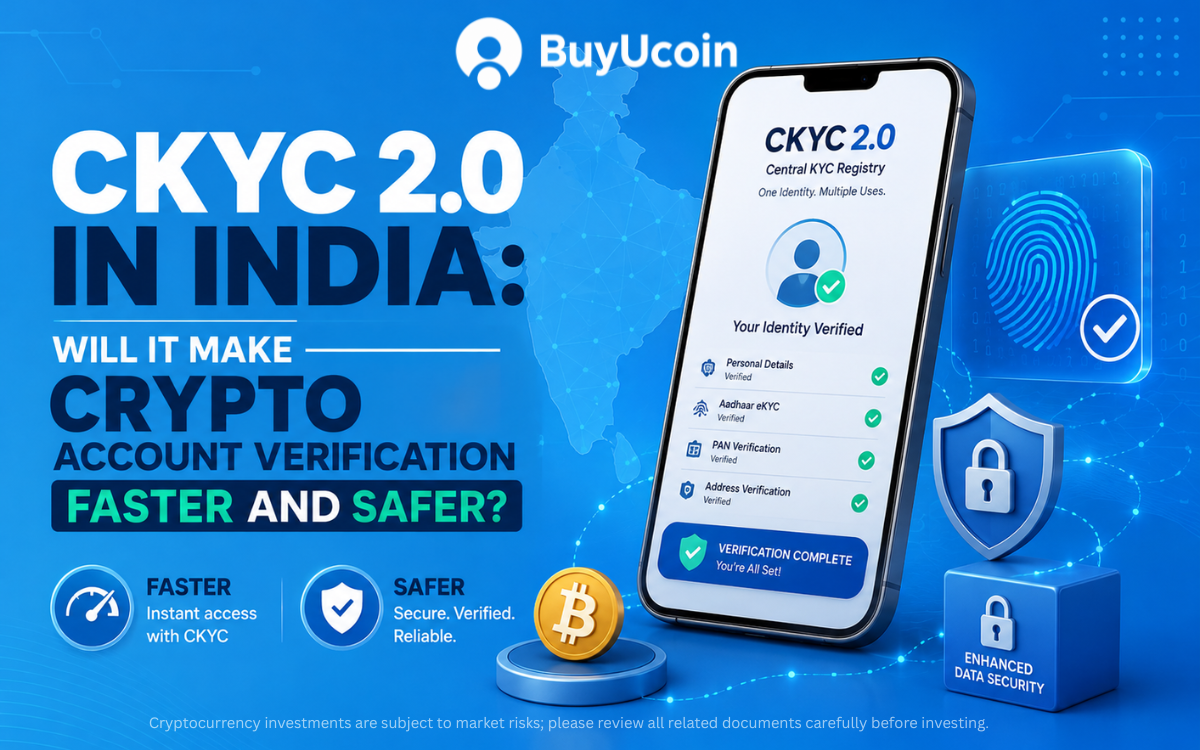
CKYC 2.0 (Central Know Your Customer 2.0) is India's upgraded centralized KYC framework designed to simplify customer verification across regulated financial institutions. Instead of submitting the same KYC documents repeatedly, eligible institutions can retrieve a customer's verified information from a central registry after obtaining their consent. While CKYC 2.0 is currently being rolled out for regulated financial sectors, there is no official confirmation that it has been integrated with cryptocurrency exchanges. However, if future regulations permit, it could significantly improve the crypto account verification experience.
At BuyUcoin, we believe understanding regulations is just as important as understanding the market. That's why we regularly publish educational resources covering blockchain technology, crypto taxation, digital asset security, and regulatory developments in India.
India's digital financial ecosystem is evolving rapidly, and CKYC 2.0 is one of its most important infrastructure upgrades. In this guide, you'll learn how the new framework works, why it was introduced, where it is being implemented, and whether it could eventually make crypto account verification faster, safer, and more seamless for Indian investors.
What Is CKYC 2.0?
CKYC 2.0 (Central Know Your Customer 2.0) is the upgraded version of India's centralized Know Your Customer (KYC) system. It is designed to eliminate repetitive identity verification by allowing regulated financial institutions to securely access a customer's verified KYC information from a central registry—with the customer's consent.
In simple terms, CKYC 2.0 follows a "Verify Once, Use Many Times" approach, reducing the need to upload the same identity documents whenever you open a new financial account.
Instead of completing KYC separately for every bank, insurance company, or investment platform, verified customer information can be securely reused through the centralized system, making onboarding faster and more efficient.
As a leading FIU-compliant exchange in India, BuyUcoin always keeps you ahead of regulatory changes...
Why Was CKYC 2.0 Introduced in India?
CKYC 2.0 was introduced to reduce duplicate KYC processes, improve customer onboarding, strengthen fraud prevention, and create a more efficient digital verification system across India's regulated financial ecosystem. As India's digital asset ecosystem continues to evolve, many investors also want to understand whether crypto is banned in India? Before completing KYC and opening an account.
Over the past few years, India's financial services industry has expanded rapidly. Today, a single person may have multiple financial relationships, such as:
Savings Account
Credit Card
Insurance Policy
Mutual Fund
Stock Trading Account
Personal Loan
Pension Account
Despite already completing KYC once, customers often have to upload the same documents repeatedly for every new financial product.
This creates several challenges:
Repetitive document submission
Longer account opening time
Higher operational costs
Duplicate customer records
Poor onboarding experience
Increased verification workload
CKYC 2.0 aims to solve these issues by creating a standardized and consent-based verification framework that can be reused across eligible regulated institutions.
Why Does CKYC 2.0 Matter?
CKYC 2.0 is not just another KYC update—it represents a shift toward a more connected digital financial ecosystem.
If implemented successfully across eligible institutions, it has the potential to:
Improve customer experience
Reduce repetitive documentation
Speed up account verification
Enhance identity validation
Support better fraud detection
Increase operational efficiency
Strengthen regulatory compliance
Rather than asking customers to prove their identity repeatedly, the system focuses on securely reusing already verified information through a consent-based model.
Key Takeaways:
CKYC 2.0 is India's upgraded centralized KYC framework designed to simplify identity verification.
It aims to reduce duplicate KYC submissions through secure, consent-based information sharing.
The framework is intended to improve customer onboarding while strengthening compliance and fraud prevention.
As of now, CKYC 2.0 is being rolled out for regulated financial institutions, and there is no official announcement confirming its integration with cryptocurrency exchanges.
In the next section, we'll explain how CKYC 2.0 works behind the scenes, which sectors are adopting it first, and what the rollout timeline looks like.
How Does CKYC 2.0 Work and Where Is It Being Implemented?
CKYC 2.0 works by allowing eligible regulated financial institutions to retrieve a customer's verified KYC information from a centralized registry after obtaining the customer's consent. Instead of submitting the same documents repeatedly, customers authorize secure data sharing, making onboarding faster, more consistent, and less repetitive. The first phase of the rollout is focused on banks and insurance companies, with mutual funds and capital market participants expected to follow.
How Does CKYC 2.0 Work?
Unlike the traditional KYC process, where every financial institution verifies your documents independently, CKYC 2.0 introduces a centralized and consent-driven verification model.
Here's how the process works:
Step 1: Complete Your KYC Once
You complete your KYC with an eligible regulated financial institution by submitting documents such as:
PAN Card
Aadhaar or another valid identity proof
Address proof
Photograph
Once verified, your information is securely registered in the Central KYC Registry (CKYCRR), which is managed by CERSAI.
Step 2: Your Verified Record Is Stored Securely
After successful verification:
Your KYC record is stored in the central registry.
A unique 14-digit KYC Identifier (KIN) is generated.
Authorized regulated institutions can retrieve your verified record instead of asking you to upload documents again.
Step 3: Customer Consent Comes First
One of the biggest improvements in CKYC 2.0 is consent-based data access.
Before another eligible institution retrieves your information:
You receive a consent request.
You approve the request (typically through an OTP or an approved authentication method).
Only after your approval can the institution access your verified KYC details.
This gives customers greater control over how and when their information is shared.
Step 4: Faster Account Opening
Instead of asking you to upload documents again, the institution can retrieve your verified information directly from the central registry.
This may reduce:
Repetitive document uploads
Manual verification
Data mismatches
Account opening time
How Is CKYC 2.0 Different from Traditional KYC?
Traditional KYC | CKYC 2.0 |
Separate verification for every institution | Centralized verification with customer consent |
Same documents uploaded multiple times | Verified information can be reused |
More manual verification | More API-driven digital workflow |
Higher onboarding friction | Smoother customer onboarding |
Duplicate customer records | Better data consistency |
Slower verification | Faster verification potential |
Which Sectors Are Adopting CKYC 2.0 First?
The rollout is being carried out in phases rather than across every financial institution at once.
Phase 1
✅ Banks
✅ Insurance Companies
Expected in Later Phases
Mutual Funds
Asset Management Companies
Capital Market Participants
Stock Brokers
The phased rollout is intended to help institutions integrate the upgraded infrastructure while improving customer onboarding across India's regulated financial ecosystem.
Who Will Benefit from CKYC 2.0?
The new framework is expected to improve the experience for both customers and financial institutions.
Customer Benefits | Institution Benefits |
Less paperwork | Faster onboarding |
One-time verification | Better data quality |
Reduced duplicate KYC | Lower operational costs |
Better digital experience | Stronger compliance |
Greater control through consent | Improved fraud detection |
What Makes CKYC 2.0 Better Than the Current System?
CKYC 2.0 is designed to improve both efficiency and trust.
Key improvements include:
Consent-based data sharing
Better verification accuracy
Improved data quality
Reduced duplicate customer records
Modern API-based integrations
Better interoperability across regulated institutions
These improvements aim to make onboarding faster without compromising compliance or customer privacy.
Is CKYC 2.0 Already Available Everywhere?
No.
Although CKYC 2.0 has been announced, its implementation is phased.
Different regulated institutions will adopt the upgraded framework according to their readiness, integration timelines, and regulatory guidance. This means customers may continue to see both traditional and upgraded onboarding experiences during the transition period.
Key Takeaways:
CKYC 2.0 replaces repetitive KYC with a centralized, consent-based verification model.
Customer approval remains mandatory before verified information is shared with another eligible institution.
Banks and insurance companies are expected to lead the initial rollout, followed by other regulated financial sectors.
The framework aims to improve onboarding speed, reduce paperwork, and strengthen compliance.
The next section answers the biggest question for digital asset users: Could CKYC 2.0 eventually make crypto account verification faster and safer if future regulations permit such integration?
Could CKYC 2.0 Make Crypto Account Verification Faster and Safer?
Possibly—but not yet.
As of now, there is no official confirmation that cryptocurrency exchanges in India are integrated with the CKYC 2.0 framework. However, if future regulations allow eligible Virtual Digital Asset (VDA) platforms to access the centralized KYC infrastructure, crypto account verification could become faster, more consistent, and more secure while reducing repetitive document submissions.
Is CKYC 2.0 Available for Crypto Exchanges Today?
The short answer is: No
The current phased rollout of CKYC 2.0 is focused on regulated financial institutions such as:
Banks
Insurance Companies
Mutual Funds (phased)
Capital Market Participants (phased)
As of the time of writing, there is no official announcement confirming that cryptocurrency exchanges are part of the CKYC 2.0 rollout.
This means crypto users still need to complete the exchange's own onboarding and KYC process as required under applicable regulations.
Why Are Crypto Investors Talking About CKYC 2.0?
Although crypto exchanges are not officially integrated today, the topic has generated significant interest because it could influence the future of digital onboarding in India.
Many investors are asking questions like:
Will crypto KYC become faster?
Will I need to upload documents every time?
Can one verified KYC work across multiple financial platforms?
Will opening a crypto account become easier?
These are reasonable questions because India's financial ecosystem is gradually moving toward more connected digital verification systems.
How Does Crypto Account Verification Work Today?
When you create an account on a cryptocurrency exchange, you typically need to complete a separate verification process.
This usually includes:
Mobile number verification
Email verification
PAN verification
Identity proof
Address verification (where applicable)
Selfie or facial verification
Bank account verification
Every regulated platform follows its own onboarding procedures based on applicable compliance requirements.
How Could CKYC 2.0 Improve Crypto Verification in the Future?
If future regulations permit eligible cryptocurrency exchanges to integrate with CKYC 2.0, the onboarding experience could become significantly more efficient.
Potential Future Benefits
Current Experience | Possible Future Experience |
Upload documents repeatedly | Reuse verified KYC with customer consent |
Manual document verification | Faster digital verification |
Longer onboarding | Reduced verification time |
Multiple KYC submissions | Centralized identity verification |
Higher verification effort | Better user experience |
These are potential outcomes based on how CKYC 2.0 is designed to work within regulated financial sectors. They should not be interpreted as confirmed features for cryptocurrency exchanges.
What Could This Mean for BuyUcoin Users?
If eligible VDA platforms are permitted to integrate with CKYC infrastructure in the future, users could benefit from a smoother onboarding experience.
Potential improvements may include:
Faster account verification
Reduced document uploads
Improved identity validation
Better fraud prevention
More consistent customer onboarding
Lower verification errors
However, these possibilities depend entirely on future regulatory decisions and implementation guidelines.
Could CKYC 2.0 Improve Security for Crypto Investors?
Potentially, yes.
A centralized and standardized verification framework may strengthen identity verification while helping reduce fraudulent account creation.
Possible security advantages include:
Better identity validation
Reduced duplicate accounts
Stronger fraud detection
Improved compliance monitoring
More reliable customer records
Even with these improvements, users must continue following basic security practices such as enabling Two-Factor Authentication (2FA), using strong passwords, and protecting their account credentials.
What Challenges Still Need to Be Addressed?
Even if crypto exchanges become eligible in the future, several practical and regulatory challenges would need to be resolved first.
Possible Challenges
Regulatory approval
Technical API integration
Data privacy requirements
Customer consent management
Cybersecurity standards
Operational readiness
Compliance with evolving VDA regulations
These factors will determine whether and how any future integration takes place.
What Should Crypto Investors Do Today?
While CKYC 2.0 continues its phased rollout, crypto investors should focus on completing KYC through compliant exchanges and following good security practices.
Best Practices
Complete KYC only through trusted platforms.
Keep your PAN and identity documents updated.
Enable Two-Factor Authentication (2FA).
Never share OTPs or verification credentials.
Stay informed about regulatory developments.
Follow official announcements instead of relying on rumours.
Our Perspective
CKYC 2.0 represents a significant step toward improving India's digital financial infrastructure.
Although cryptocurrency exchanges are not currently part of the official rollout, the framework demonstrates how customer verification could become more streamlined across regulated sectors in the future.
If policymakers eventually extend similar infrastructure to eligible VDA service providers, it could help improve onboarding efficiency while maintaining strong compliance standards. Until then, crypto exchanges will continue following their existing KYC and regulatory obligations.
Key Takeaways:
CKYC 2.0 is not currently available for cryptocurrency exchanges.
There is no official confirmation regarding CKYC 2.0 integration with VDA platforms.
If future regulations permit such integration, crypto onboarding could become faster and more efficient.
Customer consent, compliance, and data privacy would remain central to any future implementation.
Investors should rely on current regulatory requirements and official announcements rather than assumptions about future rollout.
Frequently Asked Questions (FAQs)
1. What is CKYC 2.0?
CKYC 2.0 (Central Know Your Customer 2.0) is India's upgraded centralized KYC framework that allows eligible regulated financial institutions to access a customer's verified KYC information through a consent-based mechanism. Its primary goal is to reduce duplicate KYC submissions and improve the customer onboarding experience.
2. Who manages the CKYC system in India?
The Central KYC Registry (CKYCRR) is managed by CERSAI (Central Registry of Securitisation Asset Reconstruction and Security Interest of India), which maintains centralized KYC records for eligible regulated entities.
3. Is CKYC 2.0 mandatory for everyone?
CKYC 2.0 is an infrastructure upgrade for regulated financial institutions. Whether customers interact with the upgraded workflow depends on the institution they use and the stage of implementation.
4. Has CKYC 2.0 been implemented for cryptocurrency exchanges?
No.
At the time of writing, there is no official announcement confirming that cryptocurrency exchanges are integrated with CKYC 2.0. Crypto exchanges continue to follow their existing KYC and compliance requirements.
5. Could crypto exchanges use CKYC 2.0 in the future?
Potentially, yes.
If future regulations permit eligible Virtual Digital Asset (VDA) platforms to integrate with CKYC infrastructure, customer verification could become more streamlined. However, this would depend entirely on future regulatory decisions and implementation guidelines.
6. Will CKYC 2.0 eliminate the need for KYC?
No.
CKYC 2.0 is designed to simplify and reuse verified customer information, not eliminate identity verification. Customer consent and regulatory compliance remain essential.
7. Is customer consent required before sharing KYC information?
Yes.
One of the key features of CKYC 2.0 is its consent-based verification model, where eligible institutions obtain customer authorization before retrieving verified information.
8. How could CKYC 2.0 benefit crypto investors in the future?
If eligible crypto platforms are allowed to integrate in the future, possible benefits may include:
Faster onboarding
Fewer document uploads
Better verification accuracy
Improved fraud prevention
More consistent customer experience
These are potential outcomes rather than officially confirmed features.
9. Does CKYC 2.0 improve security?
CKYC 2.0 is designed to strengthen identity verification through standardized and consent-driven data sharing. However, users should continue following good cybersecurity practices such as enabling Two-Factor Authentication (2FA) and protecting their account credentials.
10. Where can I check official CKYC updates?
For the latest implementation status and regulatory developments, refer to official announcements from CERSAI and other relevant Indian financial regulators.
Key Takeaways
CKYC 2.0 modernizes India's KYC infrastructure through centralized and consent-based verification.
Its primary objective is to reduce repetitive KYC while improving customer onboarding and compliance.
Banks and insurance companies are leading the phased rollout, with other regulated financial sectors expected to follow.
Cryptocurrency exchanges are not currently included in the official CKYC 2.0 rollout.
If future regulations permit eligible VDA platforms to participate, crypto onboarding could become faster and more efficient while maintaining strong compliance standards.
Final Thoughts
CKYC 2.0 is more than just a KYC upgrade—it represents India's broader vision of building a connected, secure, and efficient digital financial ecosystem. By reducing duplicate verification and introducing consent-based data sharing, the framework has the potential to improve customer experiences across multiple regulated financial services.
For cryptocurrency investors, the rollout is worth watching closely. Although CKYC 2.0 is not currently available for crypto exchanges, any future regulatory integration could simplify account verification and strengthen onboarding processes. Until then, users should continue completing KYC through compliant exchanges and stay informed through official regulatory updates.
Ready to Start Your Crypto Journey with Confidence?
The regulatory landscape for digital assets in India continues to evolve. Understanding developments like CKYC 2.0, taxation, compliance, and blockchain regulations can help you make more informed investment decisions.
Understanding regulations like CKYC 2.0 is the first step toward becoming a responsible crypto investor. The next step is choosing a trusted platform that prioritizes security, compliance, and a seamless user experience.
With BuyUcoin, you can:
Securely create your account
Complete KYC verification
Access educational resources to make informed investment decisions
Stay updated with the latest developments in India's digital asset ecosystem
Start your cryptocurrency journey with BuyUcoin and invest with greater confidence.
Disclaimer: This article is intended for educational and informational purposes only. It does not constitute legal, financial, investment, or tax advice. The information reflects the publicly available status of CKYC 2.0 at the time of writing. Cryptocurrency exchanges are not currently confirmed participants in the CKYC 2.0 rollout, and any discussion regarding future integration is based on potential regulatory developments rather than official announcements. Readers should always refer to official government and regulatory sources for the latest updates before making financial or compliance-related decisions.
Explore BuyUcoin's educational resources to stay updated on: