
How to Withdraw Cryptocurrency to INR in India Safely
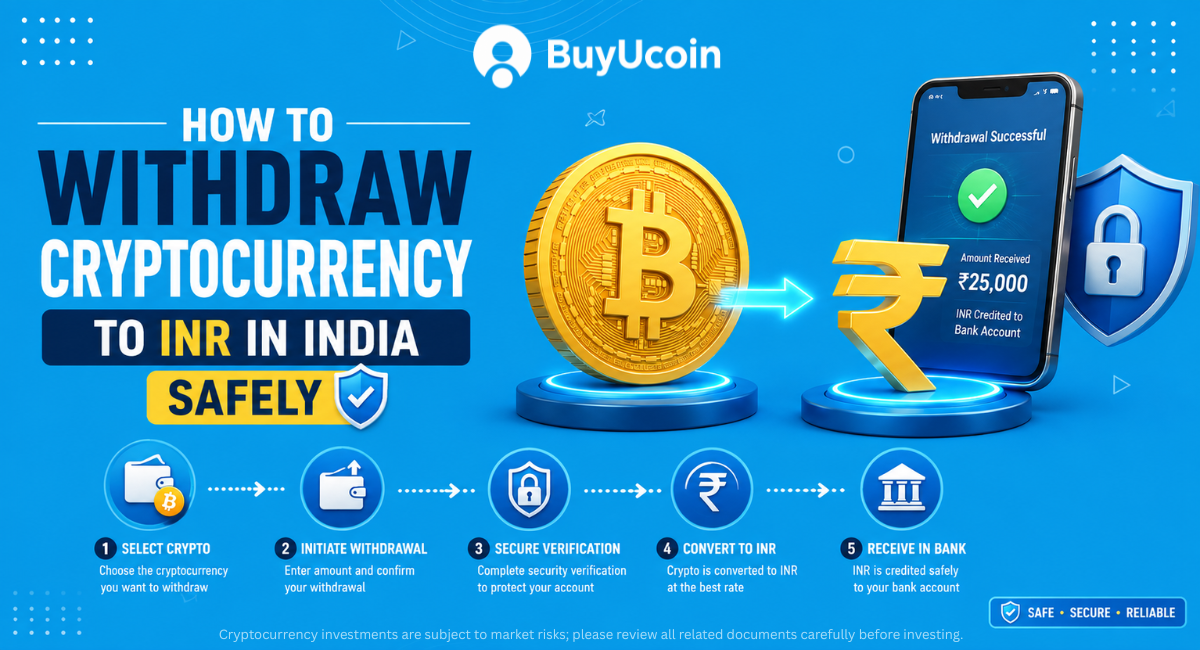
Generally you can't withdraw cryptocurrency directly to a bank account. The usual process is to sell or convert your crypto into INR through a platform like BuyUcoin that supports INR withdrawals, then transfer the available INR balance to your linked bank account. The process usually involves KYC, selling the crypto, checking fees and deductions, confirming your bank details, and keeping transaction records.
Crypto → Sell/Convert → INR → Bank Account
The safest approach is to use a suitable platform, verify every transaction detail, avoid sharing security credentials, and understand applicable fees and tax obligations.
What Do You Need Before Converting Crypto to INR?
Before initiating a withdrawal, make sure you have:
A verified account with the platform you are using
Completed KYC where required
A bank account that meets the platform's withdrawal requirements
Crypto available for sale or conversion
Correct wallet/network information if transferring crypto from another wallet
Access to your registered email/mobile number
A record of your purchase and transaction history
If your crypto is held in a self-custody wallet, you may first need to transfer the supported asset to a platform that can convert it into INR.
Never send crypto to an address without first checking the exact network and deposit instructions.
How Do You Withdraw Money From Cryptocurrency?
If you already hold Bitcoin, Ethereum, USDT, or another digital asset and want to receive real money in your Indian bank account, there are two separate actions:
Sell or convert the cryptocurrency into INR
Withdraw the resulting INR balance to your bank account
For example:
0.01 BTC → Sell BTC → INR balance → Bank account
Generally you can not send Bitcoin or USDT directly into a normal INR bank account.
Can You Withdraw Crypto to an Indian Bank Account?
Not directly as cryptocurrency.
An Indian bank account receives INR, not Bitcoin, Ethereum, USDT, or other digital assets. Therefore, the usual route is:
Cryptocurrency → INR conversion → INR withdrawal → Bank account
The exact process, supported assets, payment rails, limits, and processing times depend on the platform you use.
Type | What Happens |
Crypto withdrawal | Cryptocurrency moves to another wallet/address |
Crypto-to-INR conversion | Cryptocurrency is sold/converted into INR |
INR withdrawal | INR balance is transferred to your bank |
This distinction can prevent one of the most common beginner mistakes.
How Do You Convert Digital Assets to Indian Rupees?
The basic process is simple:
1. Hold a supported cryptocurrency
↓
2. Sell or convert it through an INR-supported market
↓
3. Receive INR balance
↓
4. Request an INR withdrawal
↓
5. Receive INR in your verified bank account
For example:
BTC → INR
ETH → INR
USDT → INR
XRP → INR
SOL → INR
The actual availability of a particular asset/INR pair can change, so always check the platform's current supported markets before transferring funds.
How to Withdraw Cryptocurrency to an Indian Bank Account: Step-by-Step
For a beginner, the safest approach is to treat the process as a checklist rather than simply pressing the withdrawal button.
Step 1: Choose a Suitable Platform
Before transferring your cryptocurrency, check whether the platform supports:
INR conversion
Bank withdrawals
Your cryptocurrency
Required KYC
Your preferred payment/withdrawal method
Transparent fees
Appropriate account-security controls
Don't choose a platform simply because it advertises the fastest withdrawal or lowest fee.
Step 2: Create Your Account and Complete KYC
Register your account and complete the required identity verification.
Depending on the platform and applicable compliance requirements, you may need information such as:
PAN
Identity information
Address information
Mobile number
Email
Bank account details
The exact documents can vary according to the platform, transaction and applicable compliance requirements.
Step 3: Add or Verify Your Bank Account
Use a bank account that belongs to you and make sure the details entered on the platform are accurate.
Before continuing, check:
Account holder name
Account number
IFSC
Bank details
Verification status
A mismatch can result in delays or withdrawal failure.
Step 4: Transfer Crypto If It Is Held Elsewhere
If your cryptocurrency is already on the platform, you can normally move directly to the selling step.
If it is in a self-custody wallet, first obtain the correct deposit address from the platform.
Then verify:
Asset → Network → Address → Memo/Tag, if required
This is critical.
Sending an asset through an unsupported network can cause funds to become difficult or impossible to recover.
For a significant transfer, using a small test transaction first can be a sensible precaution where practical.
Step 5: Sell Your Crypto for INR
Select the cryptocurrency you want to sell and choose the available INR market or conversion option.
For example:
BTC → INR
or
USDT → INR
Depending on the platform, you may have different order options.
Market Order
Executes against available market liquidity at prevailing prices.
Useful when: execution speed is more important than specifying a particular price.
Limit Order
Allows you to specify the price at which you want to sell.
Useful when: you want more control over execution price.
The important thing is to understand the order before confirming it.
Step 6: Check the INR Amount You Actually Received
Don't assume that:
Crypto sale value = final bank credit
The final amount can be affected by:
Trading fees
Spread
Slippage
Applicable TDS
Withdrawal charges, where applicable
Before withdrawing, review the transaction summary and confirm the net INR balance available.
Step 7: Withdraw INR to Your Bank
Select the verified bank account, enter the INR amount, review the transaction details and confirm the withdrawal.
Before clicking confirm, check:
Bank account
Withdrawal amount
Fees
Final amount
Transaction details
Keep the withdrawal/reference confirmation for your records.
Which Platforms Allow Direct Bank Transfers for Crypto Payouts in India?
Currently BuyUcoin provides an INR-focused crypto trading environment with KYC, INR deposit/withdrawal functionality, multiple digital assets and a published fee structure. For users who want to manage the entire journey from crypto trading to INR withdrawal within one platform, this can make the process more straightforward than manually coordinating multiple services.
When evaluating an INR off-ramp, compare:
Factor | What to Check |
INR withdrawal | Is INR withdrawal currently supported? |
KYC | What verification is required? |
Assets | Does the platform support your crypto? |
Fees | What will the complete transaction cost? |
Processing | How long can INR withdrawal take? |
Security | What account protections are available? |
Records | Can you access transaction/order history? |
Support | Is there an official support process? |
How Does INR Withdrawal Work on BuyUcoin?
Once your BuyUcoin account is verified and you have INR available after selling your supported cryptocurrency, the general workflow is:
1. Create Your Account
Sign up through the web platform or app.
2. Complete KYC
Make sure the required verification is completed.
3. Sell Your Crypto
Choose the asset you want to sell and execute the supported INR trade.
4. Check Your INR Balance
Confirm that the sale has been completed and that the expected INR balance is available.
5. Open the INR Withdrawal Option
BuyUcoin's official FAQ directs users to the account dashboard for INR withdrawal.
6. Select/Verify Your Bank Details
Make sure the bank information is correct before confirming the transaction.
7. Enter the Withdrawal Amount
Check the applicable fee and final amount before submitting.
8. Confirm the Withdrawal
Complete the required authentication and keep the transaction confirmation.
BuyUcoin also publishes its current fee structure, including trading and cryptocurrency/fiat withdrawal information, so users can check the applicable charges before transacting.
Important: Platform interfaces, supported payment methods, limits and fees can change. Always verify the information displayed in your account at the time of withdrawal.
What Are the Common Fees for Taking Out Crypto Funds?
“Crypto withdrawal fee” can actually refer to several different costs.
1. Trading Fee
The cost associated with selling your cryptocurrency.
2. Spread
The difference between the price at which an asset can be bought and sold.
3. Network Fee
Relevant when cryptocurrency is transferred on-chain between wallets/platforms.
4. INR Withdrawal Fee
A platform may charge a fee for transferring INR to a bank account.
5. TDS
Applicable VDA transactions can involve tax deducted at source under Indian tax rules.
Therefore, the lowest advertised withdrawal fee doesn't necessarily mean the lowest total cost.
What Are the Cryptocurrency Withdrawal Fees on Indian Platforms?
There isn't one universal fee across Indian platforms.
Fees can vary by:
Cryptocurrency
Blockchain network
INR withdrawal method
Account level
Transaction size
Platform
Current network conditions
Before withdrawing, review BuyUcoin’s current fees and charges to understand the applicable trading, cryptocurrency withdrawal, and fiat withdrawal costs.
How Long Does Cryptocurrency Withdrawal Take in India?
There are actually two different timelines to consider.
Crypto Transfer Time
If you're moving BTC, USDT or another asset from a wallet to an exchange, the transaction depends on the relevant blockchain and network conditions.
INR Bank Withdrawal Time
After selling the asset, INR withdrawal depends on:
Platform processing
Bank processing
Payment method
Account verification
Compliance checks
Weekends/holidays
Technical issues
So:
Blockchain confirmation time ≠ INR bank withdrawal time
A withdrawal that appears “slow” may be waiting at either stage.
For comparison, some Indian platforms explicitly publish bank-credit windows; Currently BuyUcoin states that fiat withdrawals can take up to 24 to 48 hours.
Don't promise an instant bank credit unless the platform currently guarantees it for the specific withdrawal method.
For detailed guidance on INR deposits, withdrawals, processing times, limits, and related account queries, visit the BuyUcoin INR Help Center.
Why Is It Sometimes So Hard to Withdraw From Crypto?
A failed or delayed withdrawal does not automatically mean that your money is lost.
Common reasons include:
KYC not completed
Bank details don't match
Bank account isn't verified
Insufficient INR balance
Unsupported asset/network
Withdrawal temporarily unavailable
Compliance review
Large-value transaction review
Bank processing delay
Incorrect information
Technical problems
For example, BuyUcoin's terms state that certain high-value withdrawals above ₹1 lakh or equivalent are manually verified, while lower-value crypto withdrawals are described as automatically processed under its stated policy.
If a withdrawal is delayed, first check the transaction status and official support channel rather than paying anyone who claims they can “unlock” your funds.
What Documents Are Needed to Cash Out Crypto?
The exact requirements depend on the platform and transaction.
Commonly requested information can include:
PAN
Government-issued identity information
Address information
Mobile number
Email
Bank account details
KYC verification
For certain transactions, a platform may request additional information as part of compliance or risk controls.
Do not assume every withdrawal requires every document listed above.
The correct approach is to follow the current verification requirements shown by the platform.
Is Direct INR Withdrawal Safer Than P2P?
For many beginners, a direct platform-mediated INR off-ramp can be easier to understand because the process is:
Sell crypto → Receive INR → Withdraw INR
P2P introduces another party into the transaction.
Direct INR Off-Ramp | P2P |
Platform-mediated | Counterparty-mediated |
Simpler workflow | More user involvement |
Platform transaction record | More complex payment trail |
Less direct counterparty exposure | Counterparty risk |
Generally easier for beginners | Requires additional caution |
This does not mean every P2P transaction is unsafe.
It means the user should understand additional risks such as:
Third-party payments
Fraudulent payment proofs
Counterparty disputes
Bank-account issues
Requests to move outside platform escrow
Indian crypto community discussions have also raised concerns around P2P transactions and bank-account complications, although community reports should not be treated as regulatory guidance.
How Can Beginners Safely Withdraw Crypto to INR?
Use this checklist before confirming the transaction:
Before Selling
Confirm the cryptocurrency.
Check the current market price.
Understand the order type.
Check trading costs.
Before Transferring Crypto:
Verify the deposit address.
Verify the blockchain network.
Check the memo/tag requirement.
Consider a small test transaction.
Before INR Withdrawal:
Verify your bank account.
Check the INR balance.
Review fees and deductions.
Check the final amount.
Save the transaction confirmation.
Never Share:
OTP
Password
2FA code
Private key
Seed phrase
Recovery phrase
No legitimate support process should require you to hand over your private wallet credentials.
What Happens After You Convert Crypto to INR?
Once your cryptocurrency has been sold, you have effectively moved from the digital-asset position to an INR position.
At this point you can:
Withdraw INR to your bank
Keep the INR balance where supported
Maintain records for tax purposes
Review your realised gain/loss
If you're still learning the buying side of the journey, you can also read BuyUcoin's How to Buy Cryptocurrency in India guide to understand the reverse process—from INR to digital assets.
For investors who actively trade, understanding the difference between investing and trading is also useful; our Crypto Market Trading guide can help you understand the broader trading process.
What About Tax When Converting Crypto to INR?
Converting a VDA into INR can have tax implications because the underlying transaction involves the transfer of a virtual digital asset.
Under Section 115BBH, income from the transfer of a VDA is currently subject to the applicable 30% tax regime, subject to the provisions of the law. A 1% TDS framework also applies to qualifying VDA transfers under Section 194S.
This is why you should retain:
Purchase price
Sale price
Date
Quantity
Fees
TDS information
Transaction IDs
Exchange statements
Tax treatment can depend on the circumstances, so complex cases should be reviewed with a qualified tax professional.
Pros and Cons of Converting Crypto to INR
Pros
Converts digital assets into usable INR.
Direct INR off-ramp can be easier for beginners.
Platform records can simplify transaction tracking.
You can reduce exposure to cryptocurrency price volatility.
You can move realised proceeds into your regular financial system.
Cons
Crypto prices can move before your sale executes.
Trading and withdrawal costs can reduce proceeds.
Applicable tax obligations can affect net returns.
Large or unusual transactions may trigger additional verification.
P2P can introduce additional counterparty risk.
Incorrect blockchain transfers can result in irreversible loss.
Frequently Asked Questions
Can I withdraw cryptocurrency directly to my bank account?
No. A bank account receives INR rather than cryptocurrency. You generally need to sell or convert the crypto into INR first and then withdraw the INR balance.
Can cryptocurrency be converted into real money?
Yes. Cryptocurrency can be sold or converted into fiat currency such as INR through a supported platform, after which the resulting INR can be withdrawn to a bank account.
How do I withdraw crypto to an Indian bank account?
Complete KYC, transfer supported crypto if necessary, sell it for INR, check your available INR balance, select your verified bank account, review the transaction details and submit the INR withdrawal.
How do I convert digital assets to Indian Rupees?
Sell the supported digital asset through an INR-supported market or conversion route. Once the sale is completed, withdraw the resulting INR balance to your verified bank account.
Which app is best for cryptocurrency withdrawal in India?
There is no universally best app. Compare INR withdrawal availability, KYC requirements, supported assets, fees, processing times, security controls, transaction records and customer support. BuyUcoin is an option for Indian users looking for an INR-based crypto trading and withdrawal workflow, with its current fees and withdrawal options published on its official site.
How much does crypto withdrawal cost?
The total cost depends on whether you're selling crypto, transferring it on-chain, or withdrawing INR. Trading fees, spread, network fees and fiat withdrawal charges can all be different.
How long does an INR crypto withdrawal take?
There is no universal time. It depends on the platform, bank, payment method, verification and processing conditions.
Why is my crypto withdrawal pending?
Common causes include KYC issues, bank-detail mismatches, compliance checks, platform processing, bank delays, technical issues or unsupported transactions.
What documents do I need to cash out crypto?
Requirements vary, but PAN, identity information, bank details and KYC verification may be required. Additional information can be requested for certain transactions.
Can I withdraw Bitcoin to my bank account?
Not directly. You generally sell Bitcoin for INR first and then withdraw the INR balance to your bank.
Can I convert USDT to INR?
Yes, if the platform currently supports the relevant USDT-to-INR conversion route. Always verify the supported network and trading pair before transferring USDT.
Final Thoughts: What Is the Safest Way to Withdraw Crypto to INR?
For most beginners, the clearest route is:
KYC → Transfer supported crypto correctly → Sell for INR → Check fees and deductions → Withdraw INR → Verify bank credit → Keep records
The key is not simply finding the fastest withdrawal method. A good off-ramp should give you clarity around security, fees, compliance, transaction records and the final INR amount.
And remember the most important distinction:
You don't actually withdraw cryptocurrency as INR. You sell or convert the cryptocurrency into INR and then withdraw the INR to your bank account.
That simple distinction makes the entire process much easier to understand.
Ready to Convert Crypto to INR with BuyUcoin?
If you're looking for an INR-focused platform to manage the crypto → sell → INR → bank journey, BuyUcoin provides account verification, cryptocurrency trading, INR functionality and a published fee structure.
Sign up on BuyUcoin and complete KYC.
Sell your supported cryptocurrency for INR and review the transaction details.
Withdraw your INR to your verified bank account through the available withdrawal process.
Download the BuyUcoin App to manage your digital assets on the go. BuyUcoin's app listings also describe INR deposits/withdrawals, real-time trading, KYC and account-security features.
Convert carefully. Check every detail. Keep your records.
Disclaimer: This content is for educational purposes only and does not constitute financial, tax, or investment advice. Crypto transactions involve risks, and fees, withdrawal times, and regulations may change.