
How to Buy Cryptocurrency in India: A Simple Guide
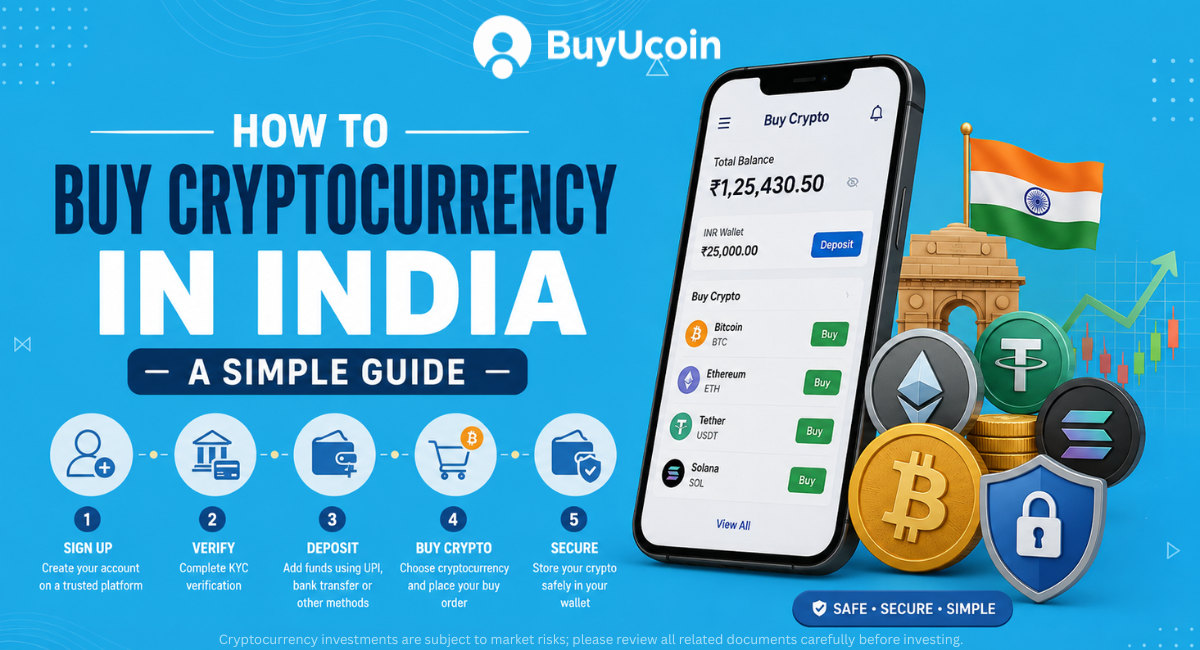
To buy cryptocurrency in India, choose a FIU registered compliant platform→create an account→complete KYC→ deposit INR through an available payment method, select the digital asset you want to purchase, review the order details, and confirm the transaction. Before buying, understand the asset, fees, risks, security requirements, and applicable Indian tax rules.
Buying digital assets is relatively straightforward. Choosing what to buy, how much to invest, and how to protect it is where most beginners need more guidance.
Is It Legal to Buy Cryptocurrency in India?
Yes, cryptocurrency is not subject to a blanket ban in India. However, cryptocurrencies are not legal tender, and transactions involving Virtual Digital Assets (VDAs) are subject to India's tax and compliance framework.
India's regulatory approach is therefore different from treating cryptocurrency like ordinary currency.
For a beginner, the practical distinction is:
Question | Answer |
Can you buy crypto in India? | Yes |
Can you sell crypto in India? | Yes |
Is crypto legal tender like INR? | No |
Is KYC required on compliant platforms? | Yes |
Are crypto gains taxable? | Yes |
Is cryptocurrency risk-free? | No |
If you want to understand India's regulatory position before making a purchase, see Is Crypto Banned in India? What the RBI Says About Cryptocurrency in 2026.
What Do You Need Before You Buy Cryptocurrency in India?
You do not need to buy a whole Bitcoin or another complete coin. Most digital assets can be purchased fractionally, allowing beginners to start with an amount that fits their budget.
Before starting, keep these things ready:
A valid mobile number
An email address
PAN and required identity information
A bank account or supported INR payment method
A device with a secure internet connection
A basic understanding of the asset you intend to purchase
More importantly, decide why you are buying.
Are you:
Building a long-term portfolio?
Learning how digital assets work?
Looking for exposure to Bitcoin?
Interested in blockchain projects?
Planning to trade more actively?
Your answer should influence what you buy and how much risk you take.
How Do You Choose a Cryptocurrency to Buy?
This is the question beginners often skip.
There are thousands of digital assets, but a lower price does not automatically mean a cryptocurrency is cheaper or has greater upside. Market capitalization, circulating supply, liquidity, utility, adoption, development activity, and risk can matter far more than the price of one coin.
Check These Factors Before Buying
Factor | What to Ask |
Use case | What problem does the project solve? |
Market cap | How large is the project compared with others? |
Liquidity | Can you buy or sell it without significant slippage? |
Adoption | Are people actually using the network or product? |
Supply | How many tokens exist and how many may enter circulation? |
Development | Is the project actively maintained? |
Risk | How much volatility can you tolerate? |
Transparency | Is reliable information about the project available? |
For beginners who want to compare different categories rather than randomly select a coin, BuyUcoin's Top 10 Best Crypto to Buy in India guide provides a broader starting point.
Should Beginners Start With Bitcoin or Other Cryptocurrencies?
There is no universally "best" cryptocurrency for every investor.
Bitcoin is often the first digital asset beginners research because of its established market presence and limited maximum supply. Ethereum is another major asset that introduces users to smart contracts and decentralized applications. Other assets can provide exposure to different blockchain ecosystems, payment networks, infrastructure, or specialized use cases.
The important point is to understand the asset before purchasing it.
If you're specifically considering Bitcoin, you can explore BuyUcoin's How to Buy Bitcoin in India guide before making a purchase.
How Do You Choose a Crypto Platform in India?
The platform you choose affects your onboarding experience, payment options, trading experience, security, and ability to manage your assets.
Instead of choosing a platform only because of an advertisement or a low headline fee, evaluate:
1. KYC and Compliance
Understand what identity verification is required and whether the platform operates within India's applicable regulatory framework.
India's AML framework covers specified VDA service activities, including exchange between VDAs and fiat currencies, exchange between different VDAs, transfer, and certain custody-related services. FIU-IND publishes AML/CFT guidance for VDA service providers.
2. INR Deposit Options
Check whether the platform supports the payment method you actually intend to use, such as UPI or bank transfer.
3. Fees
Don't look only at the trading fee.
Check the complete cost structure, including:
Trading fees
Deposit charges
Withdrawal charges
Spread
Network fees where applicable
4. Security
Look for appropriate account-security controls such as:
Two-factor authentication
Login alerts
Secure password management
Withdrawal controls
Transparent security information
5. User Experience
For beginners, a simple interface can reduce mistakes when placing the first order.
Or, simply explore our dedicated guide, “How to Choose the Right Crypto Exchange and App,” to find the best crypto platform in India.
How Do You Buy Cryptocurrency With INR?
Once your account is verified and funded, the basic purchase process is straightforward.
Step 1: Create Your Account
Register using your email address and mobile number.
Choose a strong, unique password and protect your login credentials.
Step 2: Complete KYC
Submit the required information and documents requested during verification.
KYC helps platforms meet applicable customer identification and anti-money-laundering requirements.
Step 3: Deposit INR
Add funds using an available payment method.
On BuyUcoin, the current Bitcoin buying flow includes account creation→KYC→adding funds→buying or selling the selected asset. Its Bitcoin page also currently lists INR funding options including UPI and other available methods.
Step 4: Select the Cryptocurrency
Search for the asset you want to purchase.
For example:
BTC → Bitcoin
ETH → Ethereum
SOL → Solana
XRP → XRP
USDT → Tether
Always confirm the asset name and ticker before proceeding.
Step 5: Enter Your Purchase Amount
You can generally specify either:
How much INR you want to spend, or
How much cryptocurrency you want to receive.
You don't need to purchase one complete coin.
Step 6: Review the Order
Before confirming, check:
Asset
INR amount
Quantity
Applicable fees
Final payable amount
Expected quantity received
Step 7: Confirm the Purchase
Once everything looks correct, confirm the transaction.
The purchased asset should then appear in your account balance according to the platform's transaction process.
Can You Buy Crypto With UPI in India?
UPI can be a convenient way to fund an account where the platform currently supports it.
The important distinction is that UPI is a payment method, not a type of cryptocurrency.
A simplified flow looks like this:
Bank Account → UPI/Supported INR Payment → Exchange Balance → Cryptocurrency Purchase
Before making a deposit, always verify the payment instructions displayed by the platform. Payment availability can change because of banking, regulatory, or operational factors.
How Much Cryptocurrency Should a Beginner Buy?
There is no universally correct amount.
A better approach is to start with an amount that allows you to learn without putting your essential finances under pressure.
For example, someone with a ₹50,000 monthly income should not automatically conclude that they need to invest ₹10,000 simply because a particular coin is rising.
Consider:
Monthly income
Emergency savings
Existing investments
Debt obligations
Investment horizon
Risk tolerance
A Simple Beginner Principle
Start with an amount you can afford to lose, learn how the market works, and increase exposure only when you understand the risks.
Is It Better to Buy Cryptocurrency All at Once or Gradually?
Both approaches have different risk characteristics.
Lump-Sum Purchase
You invest a larger amount at once.
Potential advantage:
If the market rises after your purchase, your entire investment participates in the move.
Potential disadvantage:
A sharp decline immediately after buying can produce a significant short-term loss.
Gradual Investing
You divide your planned investment into smaller purchases over time.
For example:
₹5,000 planned investment
Instead of:
₹5,000 → one purchase
You might use:
₹1,000 → ₹1,000 → ₹1,000 → ₹1,000 → ₹1,000
This can reduce the risk of committing your entire amount at one market price, although it does not guarantee a profit.
Pros and Cons of Buying Cryptocurrency?
Pros
Access to a new digital asset class
Ability to buy fractional amounts
24/7 market availability
Exposure to blockchain-based projects
Easy portfolio diversification across different digital assets
Potential long-term appreciation
Cons
High price volatility
Possibility of losing capital
Regulatory changes can affect the ecosystem
Security mistakes can result in asset loss
Some projects have weak fundamentals or limited adoption
Tax and reporting obligations can make transactions more complex
Cryptocurrency should therefore be approached as a high-risk asset class, not as guaranteed wealth creation.
What Happens After You Buy Cryptocurrency?
Buying is only the beginning.
After the transaction, you need to decide what you want to do with the asset.
You Can:
Hold it
Keep the asset as part of a longer-term strategy.
Trade it
Buy and sell based on a defined trading strategy and risk-management plan.
Transfer it
Move it to another compatible wallet or platform where permitted and appropriate.
Sell it
Convert it back into an available fiat or digital-asset pair according to the platform's supported markets.
For users interested in understanding the broader market before actively trading, our Crypto Trading Guide explains different trading approaches and risk considerations.
Where Should You Store Cryptocurrency After Buying It?
The answer depends on how you intend to use the asset and how comfortable you are managing wallet security.
Exchange Storage
Convenient for users who actively trade or frequently buy and sell.
Self-Custody Wallet
Gives you direct control over the wallet's private credentials, but also puts more responsibility on you.
If you use self-custody:
Never share your seed phrase.
Keep private keys confidential.
Verify addresses before sending.
Be cautious with unknown applications and links.
Understand that blockchain transactions may be irreversible.
A secure wallet does not protect you if you voluntarily give away the credentials controlling it.
What Taxes Apply When You Buy and Sell Cryptocurrency in India?
Buying cryptocurrency itself is not the same as earning taxable income from its transfer. India's VDA tax framework is particularly important when you later transfer or dispose of digital assets.
Under Section 115BBH, income from the transfer of a VDA is taxed at 30%, with the law generally allowing only the cost of acquisition as a deduction and restricting loss set-off/carry-forward for VDA transfer income.
A 1% TDS provision also applies to qualifying transfers of VDAs under the applicable rules and thresholds. The Income Tax Department's current guidance continues to address VDA transfers under the relevant TDS framework, including the transition to the 2026 tax regime.
Keep Records Of:
Purchase date
Purchase price
Quantity
Transaction fees
Sale/transfer details
TDS, where applicable
Wallet transfers
Exchange statements
Tax treatment can depend on the nature of the transaction and your circumstances, so consult a qualified tax professional when necessary.
What Mistakes Should Beginners Avoid When Buying Crypto?
The easiest way to improve your first purchase is to avoid common mistakes.
Don't:
Buy solely because a coin is trending.
Assume a low-priced coin is automatically undervalued.
Invest money needed for essential expenses.
Put your entire portfolio into one asset.
Ignore transaction costs.
Share OTPs or passwords.
Share wallet recovery phrases.
Follow guaranteed-profit claims.
Make decisions purely because of FOMO.
Ignore Indian tax obligations.
Do:
Research the asset.
Check liquidity and market conditions.
Understand the platform's fees.
Start with a manageable amount.
Enable 2FA.
Keep transaction records.
Review your strategy periodically.
Is a Cryptocurrency Under ₹100 Automatically Cheap?
No.
This is one of the most common misconceptions among new investors.
Suppose:
Coin A = ₹10
Coin B = ₹10,000
It does not mean Coin A has more room to grow simply because its unit price is lower.
The number of coins in circulation matters.
A better comparison considers:
Price × Circulating Supply = Market Capitalization
If you're specifically researching lower-priced assets, our Top 10 Best Crypto Under ₹100 in India guide explains why price alone shouldn't determine an investment decision.
Should You Buy Bitcoin, an Altcoin, or a Stablecoin?
That depends on your objective.
Asset Category | Generally Used For |
Bitcoin | Long-term exposure to the largest cryptocurrency |
Large-cap altcoins | Exposure to different blockchain ecosystems |
Stablecoins | Lower price volatility and liquidity |
Smaller altcoins | Higher-risk exposure to emerging projects |
If you want to understand how assets beyond Bitcoin are categorized, see What Is an Altcoin and Which Altcoins Have the Best Future in 2026.
The important point is that different assets serve different purposes. A stablecoin designed to track a fiat currency should not be evaluated using the same criteria as a blockchain token designed for network utility.
How Can You Make Your First Cryptocurrency Purchase Safer?
Use this five-point checklist before confirming an order:
Check | Question |
Platform | Have I verified the platform and its current compliance information? |
Asset | Do I understand what I'm buying? |
Amount | Can I afford the potential loss? |
Fees | Do I know the total transaction cost? |
Security | Is 2FA enabled and are my credentials protected? |
If you can answer all five confidently, you're in a much better position to make an informed decision.
Frequently Asked Questions About Buying Cryptocurrency in India
Can I buy cryptocurrency in India with INR?
Yes. You can buy cryptocurrency in India using INR through platforms that support INR deposits and crypto trading. For example, BuyUcoin allows users to purchase cryptocurrencies using INR, subject to available payment methods and current banking/payment availability.
What is the minimum amount required to buy cryptocurrency?
There is no universal minimum across all platforms or assets. Many platforms support fractional purchases, allowing users to start with a relatively small INR amount.
Can I buy Bitcoin without purchasing one whole Bitcoin?
Yes. Bitcoin is divisible, so you can purchase a fraction rather than one complete BTC.
Can I buy cryptocurrency using UPI?
Where supported, UPI can be used to fund an INR balance or complete a supported payment flow. Always follow the payment instructions shown by the platform at the time of the transaction.
Do I need KYC to buy cryptocurrency?
Compliant VDA service providers may require customer identification and verification as part of their regulatory obligations. FIU-IND's framework covers VDA service providers performing specified activities under India's AML framework.
Is cryptocurrency legal in India?
Cryptocurrency is not subject to a blanket ban, but it is not legal tender. VDAs are subject to taxation and applicable compliance requirements.
Is cryptocurrency safe for beginners?
The buying process can be straightforward, but the asset class carries substantial market and security risks. Beginners should start by learning how the asset works, using strong account security, and investing only what they can afford to lose.
Which cryptocurrency should a beginner buy?
There is no universally suitable choice. Bitcoin and other established assets may be the first assets many beginners research, but the decision should depend on your goals, risk tolerance, and understanding of the project.
Can I buy crypto for ₹100 or ₹500?
Whether a particular minimum is available depends on the platform and asset. Because cryptocurrencies can generally be purchased fractionally, small-value purchases may be possible.
Do I have to pay tax just because I bought cryptocurrency?
The tax consequences depend on the transaction. India's VDA tax provisions primarily address income arising from the transfer of VDAs, rather than simply owning an asset.
Is crypto profit taxed in India?
Income from the transfer of VDAs is currently taxed at 30% under Section 115BBH, subject to the applicable law.
What should I do after buying cryptocurrency?
Decide whether you intend to hold, trade, transfer, or eventually sell the asset. Also maintain transaction records and protect your account and wallet credentials.
Final Thoughts: What Is the Best Way to Start Buying Crypto in India?
The best approach is not to start with "Which coin will make me rich?"
Start with:
What am I buying?
Why am I buying it?
How much risk can I accept?
What will it cost me?
How will I secure it?
What are my tax responsibilities?
Once those questions are clear, the actual purchase becomes much simpler.
For Indian beginners, a sensible journey is:
Learn → Choose a suitable asset → Select a compliant platform → Complete KYC → Deposit INR → Buy a manageable amount → Secure your account → Maintain records → Review your strategy.
Currently BuyUcoin supports an INR-based buying journey with account creation, KYC, funding and cryptocurrency purchase, while its Bitcoin page also provides live INR pricing and multiple available funding methods.
Why BuyUcoin Can Be Part of Your Cryptocurrency Journey
Choosing a platform is only one part of investing, but the experience matters—especially when you're making your first purchase.
BuyUcoin's current buying experience combines:
INR-based cryptocurrency purchases
KYC-based account verification
Multiple available payment methods
Live cryptocurrency pricing
Access to multiple digital assets
Educational resources for beginners and investors
The goal should not be to rush into a purchase. It should be to make your first transaction with enough understanding to know what you're buying and why.
Ready to Buy Cryptocurrency in India?
Sign up on BuyUcoin and complete your KYC.
Deposit INR, explore cryptocurrencies, and check live prices.
Buy and manage your digital assets from one platform.
Download the BuyUcoin App and continue learning with our crypto guides.
Learn first. Choose carefully. Invest responsibly.
Disclaimer: This article is provided for educational and informational purposes only and does not constitute financial, investment, legal, or tax advice. Always verify the latest applicable rules and platform information before making a transaction and consult a qualified professional for advice specific to your circumstances.