
Why Low‑Fee Crypto Settlement Networks Matter for Remittances in Emerging Markets
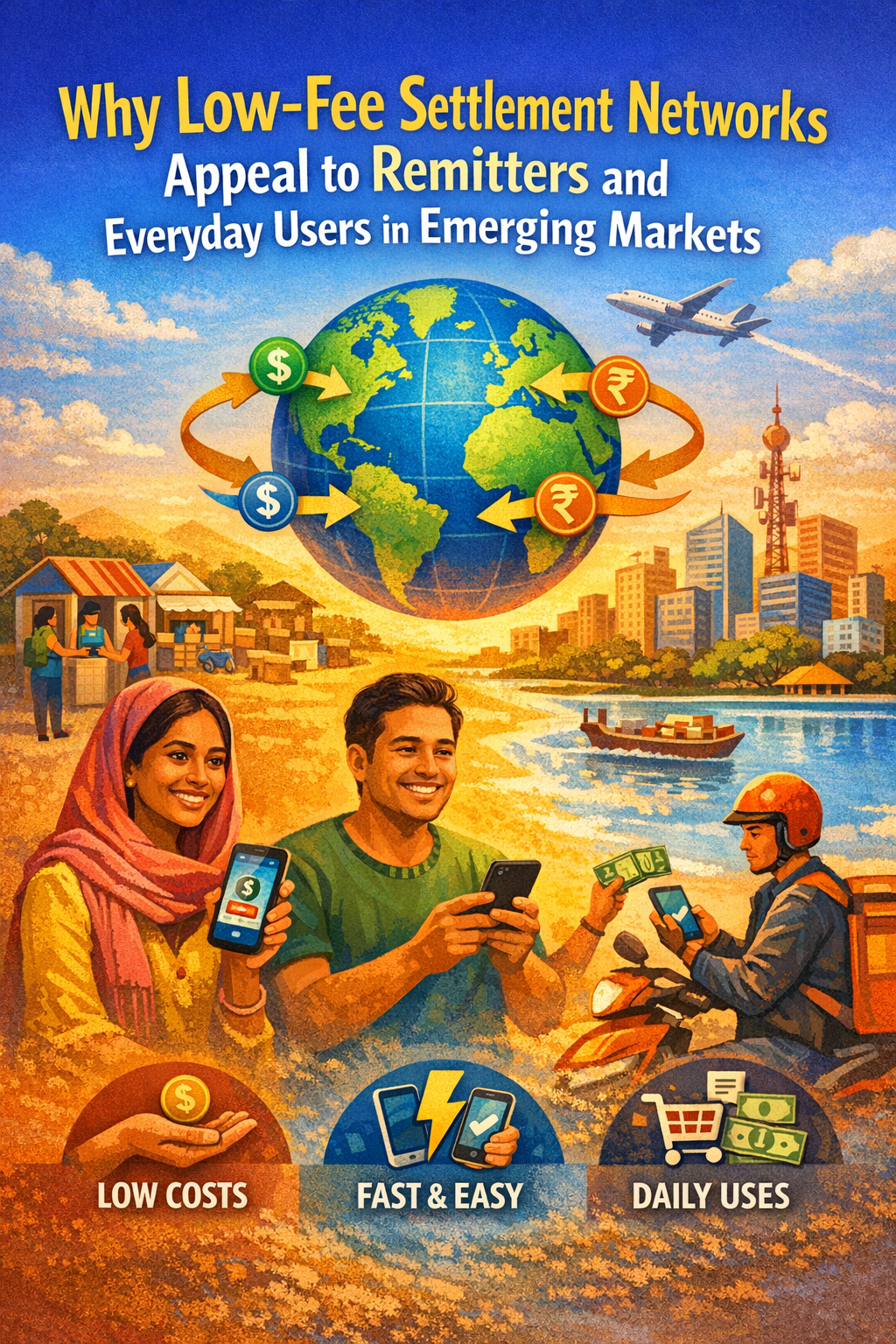
Why Low‑Fee Settlement Networks Appeal to Remitters and Everyday Users in Emerging Markets
Remittances, Everyday Payments, and the Cost Problem
Why a Few Dollars in Fees Matter So Much
Picture a nurse working abroad, sending 200 dollars home every month. At the counter or inside the app, a line of small numbers quietly eats into that amount: a flat transfer charge, a percentage fee, a less‑than‑fair exchange rate. By the time the money reaches family in an emerging market, perhaps 12 or 15 dollars are gone. Then a local bank or cash agent adds another withdrawal fee. What looks like "only a few dollars" per transfer becomes a week of groceries or several days of wages over the course of a year.
This is not a side issue. Global remittances to low‑ and middle‑income countries are now measured in the hundreds of billions of dollars each year and have overtaken many traditional forms of foreign investment. For millions of households, remittances and everyday payments are the primary safety net and investment budget rolled into one. From the company's perspective, that raises a blunt question: if these flows are so central to household income in emerging markets, why are the payment fees, FX spreads, and delays still so punishing for low‑income users? For anyone exploring on‑chain alternatives that aim to make cross‑border transfers faster and cheaper, a live view of TRX price is an especially appealing click-a quick way to understand how one of the most active payment‑focused networks is being valued by the market in real time.
The Rise of Low‑Fee Settlement Networks as an Alternative
In response to that question, a new class of low‑fee settlement networks has emerged. Instead of routing value through multiple correspondent banks and agent chains, these digital rails often move funds over blockchain infrastructure, using stablecoins or other digital assets as the medium. On these networks, the marginal cost of moving value between two wallets can be close to zero, and settlement can happen in seconds rather than days.
This article explores how those low‑fee settlement networks work in practice, why they are increasingly attractive to remitters and everyday users in emerging markets, and what providers must get right to deploy them responsibly. The focus stays on real‑world impact: not just cheaper transfers, but safer and more predictable money movement for households and small businesses.
How Traditional Remittance and Payment Rails Work Today
The Legacy Remittance Stack: Banks, MTOs, and Cash Agents
A typical cross‑border remittance still follows a familiar path. A sender walks into a bank branch or money transfer operator, or opens an app run by one of these providers. Funds are collected in cash or debited from an account, then passed into the correspondent banking system. On the other side of the remittance corridor, a partner bank or payout agent receives the funds and makes them available in local currency, either as cash at a counter or a deposit into a local account.
Each hop adds cost. Money transfer operators and banks often charge flat and percentage‑based fees. Correspondent banks apply their own charges. FX spreads between the true market rate and the rate offered to the customer quietly take another slice. Local cash agents add commissions to keep their doors open. By the time a 200‑dollar transfer lands, these layers can easily add up to 6 percent or more of the original amount-sometimes higher in smaller, riskier corridors.
Domestic Payments, Mobile Money, and Their Limitations
Inside many emerging markets, domestic payment rails have improved thanks to mobile money and faster‑payment systems. Users can send small amounts via USSD codes or smartphone apps and pay merchants with a scan or a simple phone number. These systems have been transformative, especially in regions where bank access is limited.
However, mobile money and local instant payments have constraints. They are often siloed within a single operator's ecosystem, with limited interoperability across networks or borders. Cash‑out fees can be high relative to transaction size. Moving funds from an international remittance into a local mobile wallet may still require multiple steps and additional charges. From the company's field observations, many users end up juggling two or three wallets, plus cash and informal credit, just to navigate these gaps in everyday payments.
What "Low‑Fee Settlement Networks" Actually Are
Defining Settlement Networks in Plain Language
Settlement networks are the rails that actually move value from one institution or wallet to another. In traditional finance, these rails include card networks, central bank payment systems, and correspondent banking links. In the digital asset world, blockchains and layer‑two systems play a similar role, recording and finalising transfers between addresses.
When people talk about low‑fee settlement networks, they usually mean infrastructures where the incremental cost of one more transaction is extremely small. The network itself might process thousands of transfers for a fraction of a cent each. Most of the end‑user cost then comes from on‑ramps and off‑ramps-converting between cash or bank balances and digital assets-and from compliance work like KYC and transaction monitoring. In other words, the "pipe" is cheap; what users pay for is getting in and out of it. That shift changes the economics of both remittances and small everyday payments.
Where Stablecoins and Crypto Rails Fit In
Stablecoins and certain crypto networks sit at the centre of this shift. Dollar‑backed stablecoins, for example, allow value to move across borders and between wallets while maintaining a familiar unit of account. Low‑fee blockchains provide the infrastructure to settle these movements quickly and at scale. Together, they form a middle layer between senders and receivers: funds can be collected in one country, converted into a digital dollar, sent over a cheap network, and then redeemed into local currency or spent directly in a compatible wallet.
From the company's vantage point, the appeal for many emerging market users is practical rather than speculative. Stablecoin and crypto rails are being used as faster, cheaper pipelines for moving and holding value, especially in corridors where traditional options are slow, expensive, or unreliable. The technology is complex under the hood, but when designed well, the end‑user experience can feel as simple as sending a text.
Why Remitters in Emerging Markets Are Drawn to Low‑Fee Networks
Saving on Fees and Getting More Money Home
For migrant workers sending money home, small differences in remittance fees accumulate into meaningful household gains. If a corridor currently costs around 6 percent end‑to‑end, a 200‑dollar transfer might deliver 188 dollars to the family. If a provider using low‑fee rails and efficient FX can reduce that to 3 percent or lower, the same transfer delivers 194 dollars or more. Over twelve monthly payments, the family effectively receives an extra remittance.
The company's analysis of key corridors shows that a 2-3 percentage‑point fee reduction is not just a rounding error. Those extra funds can pay school fees, cover medicine, or cushion income shocks. For senders who already stretch their own budgets to support relatives, knowing that more of each dollar actually arrives is a powerful reason to explore alternatives. When low‑fee settlement networks are wrapped in trustworthy, regulated services, the value proposition becomes hard to ignore.
Speed, Reliability, and Predictability Across Borders
Cost is only part of the story. Time and reliability matter just as much. Traditional remittances can take several days to clear, especially when weekends, holidays, or intermediary checks are involved. For families facing rent deadlines or medical emergencies, those delays are deeply stressful.
Low‑fee settlement networks, when properly integrated with local partners, can compress this timeline dramatically. Value moves between providers in minutes, not days. Payout into local wallets or bank accounts can follow quickly if on‑ramps and off‑ramps are well designed. Just as important, delivery times become more predictable. From the company's work with remittance providers, that predictability-knowing that "if money is sent now, it will arrive this afternoon"-often ranks as highly as raw speed in user surveys. It turns digital remittances into a planning tool, not just a hopeful transaction.
Everyday Users Beyond Remittances: Micro‑Payments, Commerce, and Bills
Day‑to‑Day Spending, Small Transfers, and Merchant Payments
Low‑fee settlement networks do not only change how money crosses borders; they also reshape how small sums move inside a country. When per‑transaction costs fall close to zero, entirely new patterns of micro‑payments and merchant acceptance become viable. Paying for a shared ride, splitting a meal, or tipping a delivery driver digitally no longer needs to carry a hefty percentage fee.
In pilots the company has supported, merchants in emerging markets respond quickly when settlement is cheap and fast and when funds do not sit in limbo for days. Small shops and market stalls that once preferred cash begin to accept digital payments more readily when they see that money arrives almost instantly and withdrawal fees are transparent. For everyday users, this creates a smoother loop: income comes in via digital channels, is spent digitally at local merchants, and can be saved in small increments without friction at each step.
Bill Payments, Savings, and Informal Finance Replacement
Beyond daily purchases, low‑fee settlement networks also touch less visible but equally important flows: utility bills, school fees, and informal savings. Households can use these rails to pay regular bills on time without needing to travel or queue, often at lower effective cost than cash payments through agents. When stable assets are available, small digital savings balances can accumulate over time, offering a modest buffer against shocks.
In many communities, informal lending circles and savings clubs have long filled gaps left by formal finance. With intuitive mobile interfaces built on low‑fee rails, some of that behaviour can migrate into transparent, trackable digital products. The company has seen early examples where revolving savings groups are recreated in apps, with contributions and payouts settled cheaply over digital networks. The underlying social fabric remains; the rails simply become more efficient and less leaky.
Trust, Volatility, and FX: The Real Risk Calculus for Users
Fees Are Not the Only Risk: Volatility and Counterparty Concerns
Even when settlement is almost free, users in emerging markets do not make decisions on fees alone. They worry-often with good reason-about volatility in the assets used for transfer, the stability of the platforms they rely on, and the risk of fraud or scams. A transfer that costs pennies but can suddenly lose value in transit is not an attractive proposition for someone sending a large share of their income.
The company's user research across several markets shows that trust in brands, clear communication, and accessible local support channels frequently outweigh technical features in adoption decisions. Users want to know who stands behind a service, how to get help if something goes wrong, and whether their money can disappear due to an obscure bug or exploit. Successful low‑fee solutions in emerging markets tend to pair cutting‑edge rails with very traditional trust‑building tools: local partners, physical presence, and simple, honest explanations.
FX Spreads, Local Currencies, and "Invisible" Costs
Foreign exchange remains a central part of the equation. Even if funds move over a low‑fee settlement network using digital dollars or another stable asset, sooner or later most families need value in local currency. Each conversion can involve an FX spread-the difference between the market rate and the customer rate-that quietly increases the true cost of a transfer. Cash‑out fees at ATMs or agents add another layer.
For this reason, the company encourages providers and investors to think in terms of all‑in cost rather than just the base network fee. The best products in this space communicate that total cost clearly: network fee, spread, and any local charges. When low‑fee settlement rails are combined with competitive FX and fair cash‑out options, the effective savings can be substantial. When they are not, the benefit of a cheap underlying rail can be largely consumed by "invisible" charges elsewhere in the chain.
Case Snapshots: How Low‑Fee Networks Are Already Shaping Emerging Market Flows
A Corridor Where Digital Dollars Replace Cash‑Heavy Remittance Chains
Consider a composite corridor assembled from several live deployments. Migrant workers in a developed market use a regulated app to top up balances from their bank accounts. The app converts funds into a regulated dollar‑backed stablecoin and sends them over a low‑fee settlement network to a partner in an emerging market. On arrival, the stablecoins can be redeemed into local currency through a wallet linked to mobile money or bank accounts, or spent directly with participating merchants.
From the company's analysis, the all‑in cost for users in such setups-network fees, FX, and local charges-can undercut traditional options by several percentage points, while delivery time shrinks from days to minutes. Customer satisfaction tends to rise not just because of lower fees, but because senders and receivers can track transfers end‑to‑end in real time and know precisely when funds are available.
Everyday Domestic Use in a Mobile‑First Emerging Market
In another composite scenario, a local fintech in a mobile‑first market builds a wallet that quietly uses low‑fee settlement rails under the hood. Users top up through agents or bank transfers, then pay for groceries, transport, and airtime at merchants that accept QR or NFC payments. Peer‑to‑peer transfers between friends or family cost almost nothing and settle instantly. Bill‑pay features let households clear utilities and school fees from the same balance.
Over time, the company has observed that such designs change behaviour. Cash usage declines as people grow comfortable with digital balances that are easy to move and cheap to use. Small leftover amounts that would once have been spent impulsively or lost in physical change can remain in the wallet as informal savings. For many, this is their first sustained relationship with a semi‑formal financial product, built not around credit but around efficient, low‑cost payments.
Conclusion: Building and Backing the Next Cycle of Everyday Money Movement
Using Low‑Fee Settlement Networks as a Tool, Not a Slogan
Low‑fee settlement networks are not a magic wand, but they are a powerful tool. They directly address one of the most stubborn problems in emerging‑market finance: the high cost and friction of moving small amounts of money where they are needed most. By combining cheap, fast rails with thoughtful design, transparent pricing, and strong local partnerships, providers can deliver more of each remittance and payment to the people who earn and rely on it.