
What PCI-DSS compliance actually means for platforms handling your money
You're topping up a crypto wallet, or paying for something on a fintech app, and just above the card field there's a small grey badge: PCI-DSS Compliant. You've seen it a hundred times. You've probably never clicked it.
Most people treat that badge the way they treat a "Secure" padlock icon, as background noise that vaguely means "this is fine." It means something more specific than that, and once you know what it promises, you can tell the difference between a platform that takes your card data seriously and one that's hoping you won't ask.
Here's what the standard is, what it actually requires, and how to read it as a user.
What is PCI-DSS?
PCI-DSS stands for the Payment Card Industry Data Security Standard. It's a set of security rules that any business storing, processing, or transmitting card data has to follow.
The part that surprises people: it isn't a law. No government wrote it. It was created and is enforced by the card networks themselves, Visa, Mastercard, American Express, Discover, and JCB, through a body called the PCI Security Standards Council. The current version is PCI DSS 4.0.1, which became the only active standard after the older 3.2.1 was retired in March 2024.
"Not a law" makes it sound optional. It isn't. A business that fails to comply can be fined by the card networks, made to cover the cost of fraud, or have its ability to accept cards pulled entirely. For a fintech platform or an exchange, losing card processing is close to losing the business. So while there's no police force behind PCI-DSS, the commercial teeth are real, and they apply to any platform serving Indian customers that touches a card number.
What the standard actually asks for
PCI-DSS is built around twelve core requirements, grouped under a handful of goals. You don't need to memorise all twelve. The shape of them tells you what a compliant platform is being forced to do behind the scenes.
Protect the data in transit and at rest. Card details have to be encrypted while moving across networks and while sitting in storage, so that intercepting the traffic or breaching a database yields scrambled data rather than usable card numbers.
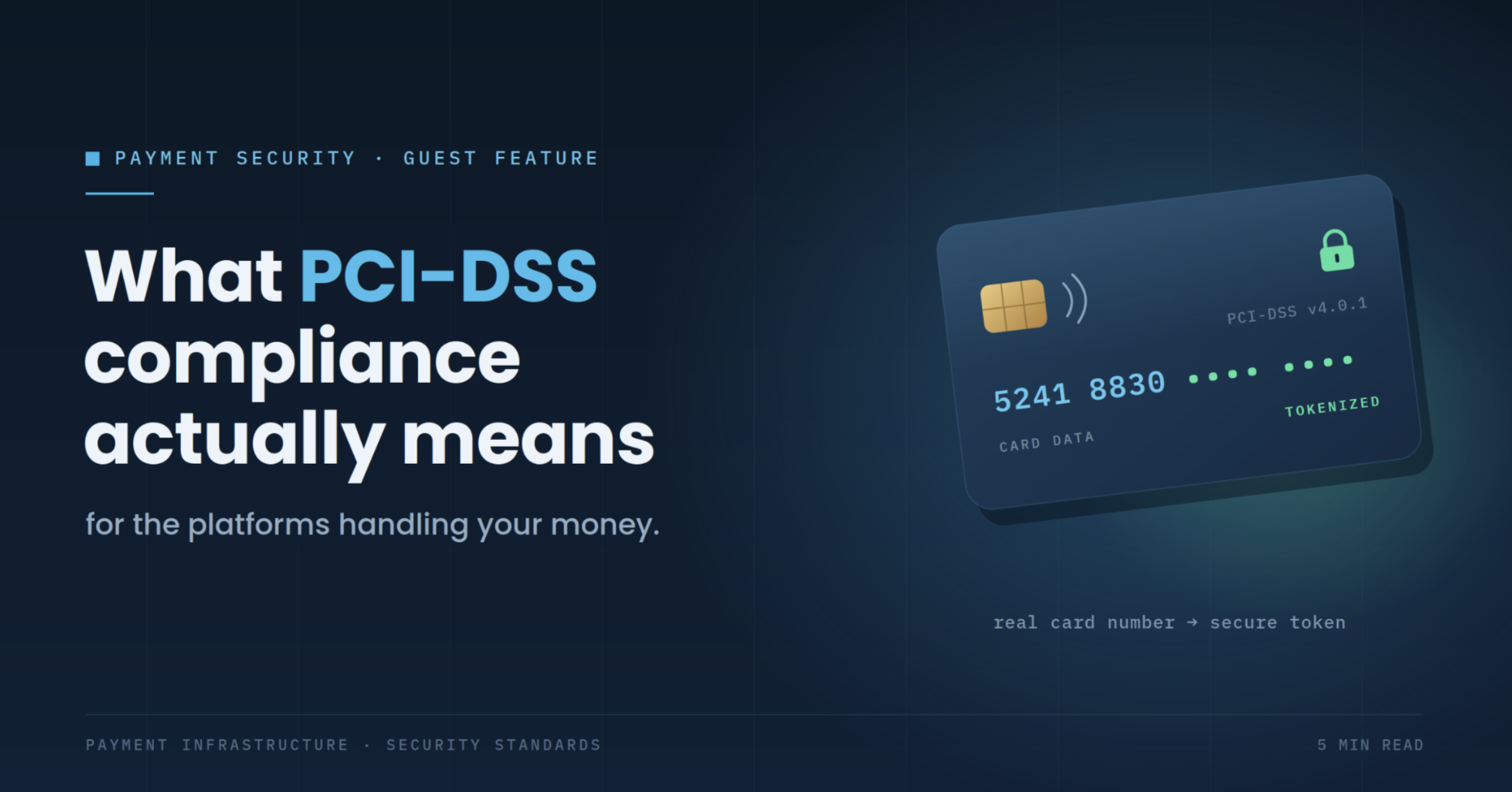
Don't hold what you don't need. The standard pushes hard against storing raw card data at all. This is where tokenization comes in: instead of keeping your actual card number, a compliant system swaps it for a random stand-in token that's useless to a thief. Your real number lives, briefly, only inside heavily guarded systems.
Lock down who can get near it. Access to cardholder data has to be restricted to the few people whose jobs genuinely require it, with unique logins and multi-factor authentication. A well-run platform is designed so that even its own engineers can't casually pull up your full card details.
Watch everything, constantly. Compliance isn't a one-time certificate. It requires logging, monitoring, and regular testing, including penetration tests that actively try to break in, so gaps get found before attackers find them.
That last point matters more than the badge itself. PCI-DSS 4.0 leaned further into continuous security rather than an annual box-tick, which is a quiet admission that a certificate from eleven months ago tells you very little about today.
Why "compliant" isn't one thing
Two platforms can both claim PCI-DSS compliance and be held to very different bars. The standard sorts businesses into four levels based on how many card transactions they handle a year.
Level 1 is the most stringent, for the highest-volume processors (broadly, those above six million card transactions annually). These require an on-site audit by an external Qualified Security Assessor and a formal Report on Compliance every year.
Levels 2 to 4 handle progressively lower volumes and are usually allowed to validate through a Self-Assessment Questionnaire rather than a full external audit.
The gap between a Level 1 audit and a self-assessment is the gap between "an independent expert spent days trying to break this" and "the company filled out a form about itself." Both are technically compliant. They are not the same promise. Payment processors and large fintech platforms typically sit at Level 1, precisely because they carry the card-data risk for everyone plugged into them.
Where compliance actually lives
Here's the piece most explainers skip, and it changes how you should think about the badge.
When you pay on a crypto exchange or a fintech app, that platform often never touches your raw card number at all. It hands the transaction off to a payment gateway, and the gateway carries the PCI-DSS burden. The card data flows into the gateway's audited environment, gets tokenized, and the platform you're using only ever sees the token and a success or failure. This is deliberate. Routing card data through a specialised, Level 1 compliant gateway shrinks the number of systems exposed to it, which is exactly what the standard wants.
It's also why the real security question is rarely "Is this app compliant?" and more usefully, "What's handling the payment underneath it?" In India, that underlying layer is a competitive field of PCI-DSS compliant gateways, Razorpay, Cashfree, and EnKash among them, each maintaining the audits, encryption, and tokenization the standard demands so the platforms building on top of them don't have to reinvent it. When an exchange advertises a "PCI-DSS Compliant Payment Gateway," this is usually what it's pointing at: not the app you're looking at, but the vetted plumbing behind it.
Knowing that, the badge becomes a question you can actually ask. Compliant at what level, and validated by whom?
Why this matters more on a crypto platform
Every platform handling card data carries this risk. Crypto exchanges carry a sharpened version of it.
An exchange sits at the meeting point of two valuable things: your payment credentials and your digital assets. The fiat on-ramp, the moment you move rupees in by card, UPI, or net banking to buy crypto, is a security-critical juncture that attackers pay close attention to. It's tempting to obsess over wallet security and private keys while treating the "add money" step as routine. The add-money step is where your card data enters the picture, and it deserves the same scrutiny.
India's regulators have pushed the ecosystem in this direction too. Since late 2022, the Reserve Bank of India's card-on-file tokenization rules have required that merchants and payment aggregators stop storing actual card numbers, replacing them with tokens, which is PCI-DSS thinking written into local regulation. The result is that a platform serving Indian users now has both an industry standard and a regulator pointing at the same practice.
How to actually judge a platform
You can't audit a company yourself. You can read the signals that tend to travel with the ones that take this seriously.
Look past the badge to the claim behind it. A platform confident in its security will name its compliance level or its gateway partner, not just display a logo.
Check whether card details are tokenized rather than stored. Good platforms say so plainly in their security or privacy documentation.
Confirm the basics are present: HTTPS across the whole site, and two-factor authentication on your account, not just at login but for withdrawals.
Read the security page. If it's specific, that's a decent sign. If it's a wall of reassuring adjectives with no detail, treat that as the answer.
None of these guarantees safety. Compliance is a floor, not a ceiling, the minimum a serious platform clears before it starts building real security on top. The best operators treat the certificate as day one, then add fraud monitoring, cold storage, and controls that are never mentioned. A platform that talks about PCI-DSS as its finish line has told you where its security thinking stops.
The badge was never meant to end the conversation. It's meant to start a better one, and now you can have it.
Frequently asked questions
Is PCI-DSS a legal requirement in India?
Not directly. PCI-DSS is enforced by the card networks through contracts, not by Indian law. But the RBI's tokenization rules cover overlapping ground and are regulatory, so platforms serving Indian users effectively face both.
Does a PCI-DSS badge mean my card data is stored securely?
It means the platform, or the gateway behind it, is held to standards for how card data is handled, ideally by not storing your raw number at all. It doesn't tell you the platform's compliance level or when it was last validated, which is worth checking.
What's the difference between PCI-DSS and encryption?
Encryption is one control PCI-DSS requires. The standard is the full rulebook, covering access controls, monitoring, testing, and tokenization alongside encryption.
Can a small platform be PCI-DSS compliant?
Yes, usually through a self-assessment rather than a full external audit. That's why the compliance level matters: it tells you how rigorously the claim was checked.