
How to Report Crypto in ITR: Schedule VDA Filing Guide (Step by Step)
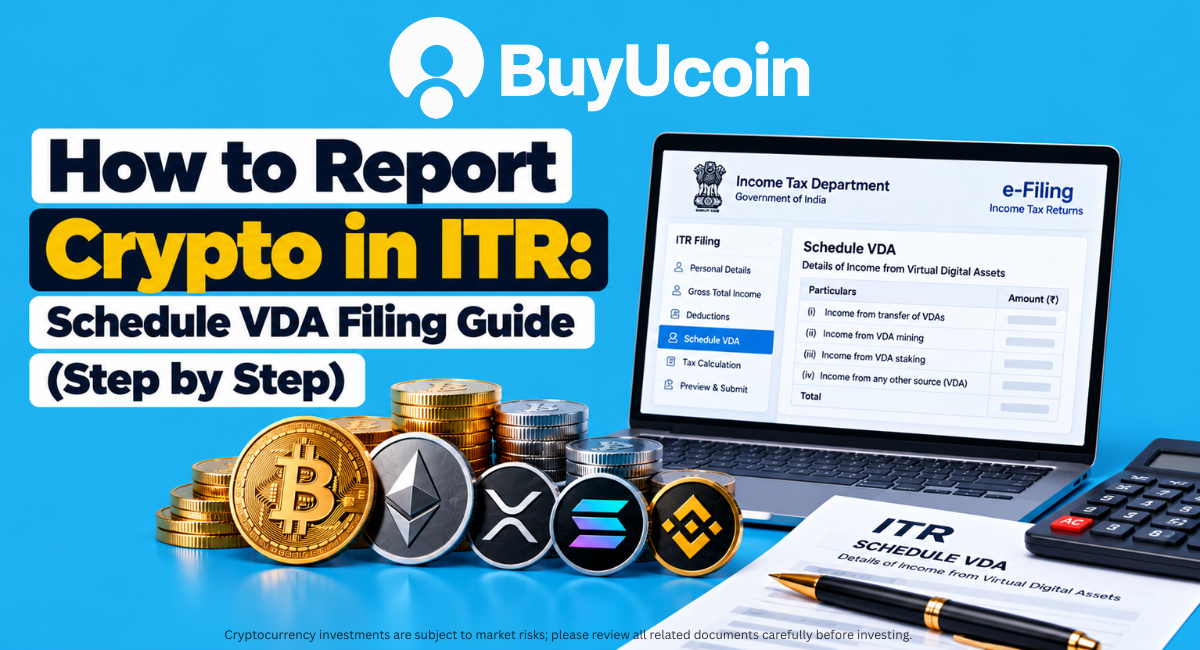
You bought a little Bitcoin, sold some, and now it’s filing season. Your salary ITR used to take 10 minutes. This time there’s a section called Schedule VDA, and it wants dates, costs and a row for every trade. It looks harder than it is. The work is mostly in getting your records ready. Once you have them, the form is just data entry.
Use ITR-2 if you’re an investor with no business income, or ITR-3 if you trade as a business. Both have Schedule VDA, where each crypto transfer goes on its own row. ITR-1 and ITR-4 can’t be used if you have crypto income.
This guide covers:
Which ITR form to pick
What to collect before you start
What each Schedule VDA field means
A worked example, including a loss row
Deadlines and late fees for AY 2026-27
Mistakes that trigger notices
Which ITR form should I use for crypto?
Your situation | Form |
Salary or other income, plus crypto as an investment | ITR-2 |
Crypto trading is your business, or you also have business or professional income | ITR-3 |
You were planning to use ITR-1 or ITR-4 | Not allowed with VDA income |
This catches many salaried people. Even a ₹100 crypto gain moves you out of ITR-1.
If you’re not sure whether your trading counts as a business, that’s worth a short chat with a CA. Frequency, volume and intent all matter.
What do I need before I start filing?
Gather these first. It saves hours later.
Trade history and profit/loss report from every exchange you used this year.
Form 26AS and AIS from the income tax portal. They show the TDS deducted on your sales.
Deposit and withdrawal history, so you can trace where coins came from.
Records for anything outside exchanges: airdrops, staking, mining, wallets, foreign platforms.
Exchanges now report crypto transactions to the department, and the penalty rules for platforms that don’t report began on 1 April 2026. So your AIS may already show data. Match your records to it before you file.
How do I fill Schedule VDA field by field?
Each transfer gets one row.
You’ll be asked for:
Field | What it means |
Date of acquisition | The date you bought or received the asset |
Date of transfer | The date you sold, swapped or spent it |
Cost of acquisition | What you paid, in rupees |
Consideration | What you received, in rupees |
Head of income | Capital gains (ITR-2) or business income (ITR-3) |
Income from transfer | Consideration minus cost |
Don’t enter one big total. The schedule expects transaction-level data.
Which purchase do I match to a sale if I bought the same coin many times?
There’s no single method written into the form. Many taxpayers use FIFO (first in, first out) because it’s easy to explain. Pick a method with your CA and stick with it.
What about coin-to-coin swaps?
The swap is the transfer. You need the rupee value of the coin at that moment. Most exchange reports and portfolio tools can give you this.
What does a filled Schedule VDA look like? (Worked example)
Coin | Acquired | Transferred | Cost | Sale value | Income |
Bitcoin | 10-01-2026 | 15-03-2026 | ₹1,50,000 | ₹2,20,000 | ₹70,000 |
Ethereum | 05-05-2025 | 20-02-2026 | ₹60,000 | ₹80,000 | ₹20,000 |
Dogecoin | 12-06-2025 | 08-01-2026 | ₹30,000 | ₹18,000 | Loss (no relief) |
Taxable VDA income is ₹90,000, not ₹78,000, because the Dogecoin loss can’t be set off. Tax: 30% of ₹90,000 = ₹27,000, plus 4% cess = ₹28,080.
If TDS was deducted on these sales, you subtract it. For example, 1% on total sale value of ₹3,18,000 = ₹3,180. Visit our web page VDA tax guide for taxation rules in India.
How do I claim my TDS credit?
Open Form 26AS or AIS and look for entries under Section 194S. Check that the amount matches your exchange’s statement, then confirm it appears in your return’s TDS schedule. If a deduction is missing, ask the exchange before you file, not after.
What about staking, mining, airdrops and foreign exchanges?
Staking and mining rewards are generally taxed as income from other sources. The treatment can differ by case, so check with your CA.
Gifts of crypto from non-relatives above ₹50,000 in a year can be taxable.
Crypto on foreign exchanges or wallets may need disclosure in Schedule FA if you’re a resident, in addition to Schedule VDA.
What are the deadlines and late fees for AY 2026-27?
For FY 2025-26 (AY 2026-27):
Who | Due date |
ITR-2 (non-audit individuals) | 31 July 2026 (passed) |
ITR-3 (business, non-audit) | 31 August 2026 (passed) |
Belated return | 31 December 2026 |
If you missed the date, you can still file a belated return until 31 December 2026. You’ll pay a late fee under Section 234F (₹5,000, or ₹1,000 if income is up to ₹5 lakh) and interest under Section 234A (1% per month on unpaid tax). After 31 December, the only route is an updated return with extra tax.
From FY 2026-27, the Income-tax Act, 2025 applies and forms may look different. Always check the official portal for the latest.
How do I actually file and finish?
On the e-filing portal, go to File Income Tax Return, choose the assessment year, pick online or offline, and select ITR-2 or ITR-3. Fill each schedule, pay any balance tax, submit, and e-verify. A return that isn’t verified is treated as not filed.
What mistakes cause trouble?
Using ITR-1 or ITR-4 with crypto income
Reporting one total instead of row by row
Ignoring swaps because “no money came to my bank”
Not matching TDS with AIS
Leaving out loss trades or foreign holdings
Waiting until the last week, when exchange reports are slow to download
Pros and cons of filing crypto taxes yourself
Pros
Saves CA fees on simple returns; you understand your own numbers; the portal pre-fills TDS data.
Cons
Swaps and wallet transfers are easy to miss; errors can lead to notices; many trades take real time.
Conclusion
With a clean trade report, a matched AIS and the right form, Schedule VDA is manageable. If you have a handful of trades on one exchange, you can do it yourself. If you have swaps, DeFi, foreign wallets or business-style trading, a CA is worth it. Understanding why losses can’t be netted will help you read your own numbers. And if you’re just beginning, check how much money to start with before you open an account at BuyUcoin.
FAQs
Which ITR form is used for crypto?
ITR-2 for investors, ITR-3 for business income.
Can I use ITR-1 for a tiny crypto gain?
No. Any VDA income rules out ITR-1.
Do I report crypto I haven’t sold?
Unsold crypto on Indian exchanges isn’t taxed. Foreign-held crypto may need Schedule FA disclosure.
What goes in “date of acquisition”?
The date you bought, received or earned the asset.
What is “date of transfer”?
The date you sold, swapped or spent it.
Do I report a very small trade?
Yes, there’s no minimum.
My exchange deducted TDS, but I made a loss. What do I do?
Report the trade, claim the TDS credit and ask for the refund.
Can I deduct trading fees?
Only the cost of acquisition is allowed. Ask your CA about including the buying fee in the cost.
What if I missed the due date?
File a belated return before 31 December 2026 and pay the late fee and interest.
Do I need a CA?
Not always. For many trades, swaps or foreign wallets, yes.
Simplify Your Crypto Tax Reporting with BuyUcoin!
Filing Schedule VDA doesn't have to be complicated. BuyUcoin provides automated trading reports and tax statements to make your ITR filing seamless and accurate. Create your account today to access smooth tax-reporting tools and trade with peace of mind.
👉 Sign Up for a Free BuyUcoin Account
Track & Trade Anytime, Anywhere:
Disclaimer: This guide is for educational purposes only. BuyUcoin is not liable for your profits, losses, or tax filing errors. Tax laws can be complex, so please do your own proper research (DYOR) or consult a certified tax professional before submitting your ITR.