
Bitcoin vs Gold vs Nifty 50: 5 Year Returns, Risk & Performance (2020–2025)
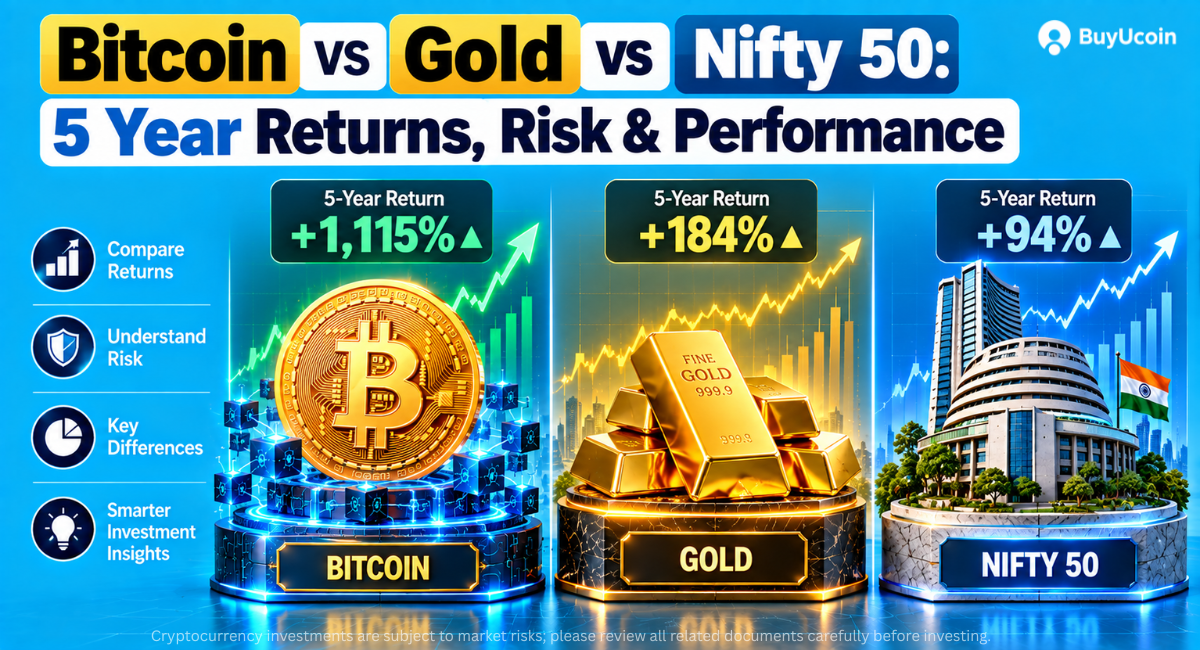
If you invested ₹1 lakh in Bitcoin on January 1, 2020, it would be worth approximately ₹12.15 lakh by December 31, 2025. The same amount in Gold would have grown to ₹2.84 lakh, and in Nifty 50 to approximately ₹1.94 lakh. These three numbers tell a story that every Indian investor needs to understand — not to chase past returns, but to make smarter decisions about where their money works hardest.
This article covers the verified lat 5-year return comparison (January 1, 2020 to December 31, 2025) of Bitcoin, Gold, and Nifty 50 — three of the most popular asset classes available to Indian investors. All data is sourced from publicly available market records. This is not financial advice.
Comparative Overview at a Glance
Metric | Bitcoin (BTC) | Gold (XAU) | Nifty 50 |
Asset Type | Digital / Crypto | Commodity / Safe Haven | Equity Index |
Core Role | High-Growth / Speculative | Inflation Hedge / Stability | Productive Growth / Equities |
Volatility / Risk | Extreme (drawdowns of 50–80%) | Low to Moderate | Moderate (market-tied) |
Return Profile | Highest historical absolute returns, cyclical | Stable, defensive capital preservation | Consistent long-term compounding via corporate earnings |
Liquidity | 24/7 global trading | High (ETF, physical, digital) | High (NSE trading hours) |
Regulated in India | Yes (FIU-registered exchanges) | Yes (SGBs, ETFs, physical) | Yes (SEBI-regulated) |
Best For | High risk tolerance, long horizon | Capital preservation, diversification | Steady long-term wealth creation |
5-Year Price Journey: Where Did Each Asset Start and End?
Asset | Jan 1, 2020 | Dec 31, 2025 | Source |
Bitcoin (BTC/USD) | ~ $7,200.17 | ~ $87,501.95 | StatMuse / CoinMarketCap |
Gold (XAU/USD per oz) | ~ $1,517.24 | ~ $4,315.13 | StatMuse / pricegold.net |
Nifty 50 Index | ~ 12,352 | ~ 23,909 | NSE / Business Standard |
₹1 Lakh Invested on January 1, 2020 — What Was It Worth by December 31, 2025?
This is the question every investor wants answered. Here is the verified calculation using actual historical closing prices.
Asset | Investment | Value Dec 31, 2025 | Total Return | CAGR |
Bitcoin | ₹1,00,000 | ~ ₹12,15,276 | ~ (+1,115%) | ~64.8% p.a. |
Gold | ₹1,00,000 | ~ ₹2,84,407 | ~ (+184%) | ~23.3% p.a. |
Nifty 50 | ₹1,00,000 | ~ ₹1,93,565 | ~ (+94%) | ~14.1% p.a. |
Note on calculation methodology: Bitcoin and Gold returns are based on USD price change and represent the approximate INR equivalent, assuming the USD/INR rate moved proportionally. Nifty 50 return is based on the price index (not the Total Return Index, which would add ~1.5–2% p.a. from dividends). Past performance does not guarantee future results. This table is for educational comparison only.
Year-by-Year Performance Breakdown (2020–2025)
Understanding how each asset behaved in each year is more important than just looking at the 5-year total. The journey reveals volatility, risk, and the reliability of each asset class.
Year | Bitcoin Return | Gold Return (USD) | Nifty 50 Return |
2020 | ~(+302%) | ~(+25%) | ~(+15.3%) |
2021 | ~(+60%) | ~(-3.6%) | ~(+24.1%) |
2022 | ~(-65%) | ~(-0.4%) | ~(+4.3%) |
2023 | ~(+157%) | ~(+13.1%) | ~(+20.0%) |
2024 | ~(+121%) | ~(+27.2%) | ~(+8.8%) |
2025 | ~(-7%) | ~(+65%) | ~(0.7%) |
Key observation: Bitcoin was the top performer in 4 out of 6 years — but also the worst performer in 2022 (-65%) and delivered negative returns in 2025 (-7%). Gold's 2025 was its standout year (+65%). Nifty 50 was the most consistent, posting positive returns in all 6 years.
Bitcoin vs Gold: The Digital vs Physical Safe Haven Debate
What Made Bitcoin Outperform Everything?
Bitcoin's 5-year return of ~ (+1,115%) was driven by a convergence of powerful structural forces. The COVID-19 pandemic in 2020 prompted unprecedented global money printing, which pushed investors toward assets with finite supply. Bitcoin's 21 million coin cap made it an attractive inflation hedge narrative. The 2024 Bitcoin halving reduced new supply, and the approval of spot Bitcoin ETFs in the United States in January 2024 brought institutional capital at scale for the first time. By 2025, Bitcoin reached an all-time high above $126,000 before ending the year around $87,500.
However, the same asset fell ~65% in a single year (2022) when interest rates rose and speculative froth exited the market. Investors who bought at the 2021 peak near $67,000 had to wait almost two years to recover their principal.
What Made Gold Shine — Especially in 2025?
Gold's 5-year return of ~ (+184%) is impressive for a traditional safe-haven asset with "low to moderate" volatility. Gold's strength accelerated in 2025, when it rose approximately 65% in a single year — its best annual performance in history. Drivers included geopolitical tensions, central bank gold accumulation by countries like China and India, a weakening US dollar, and flight to safety amid global economic uncertainty. Gold hit a new all-time high above $4,500 per ounce in late 2025. (Source: exchange-rates.org, JM Bullion)
Bitcoin vs Gold: What the Numbers Actually Mean
Factor | Bitcoin | Gold |
5-Year Return | ~ (+1,115%) | ~(+184%) |
Worst Single Year | ~(-65%) (2022) | ~(-3.6%) (2021) |
Best Single Year | ~(+302%) (2020) | ~(+65%)(2025) |
Max Drawdown (historical) | ~(-83%) (2022 cycle) | ~(-20%) (2022) |
Correlation with Equities | Moderate to high (risk-on) | Low (safe haven) |
Inflation Hedge Narrative | Emerging | Established for centuries |
24/7 Tradability | Yes | Partial (ETFs, digital gold) |
Storage Cost | Near zero (digital) | Physical: significant |
The takeaway: Bitcoin offers extraordinary return potential with extraordinary risk. Gold offers steady, defensive returns that protect wealth during crises. They are not substitutes — they serve different functions in a portfolio.
Bitcoin vs Nifty 50: Crypto vs India's Growth Story
What Does the Nifty 50 Represent?
The Nifty 50 is a basket of India's 50 largest listed companies by free-float market capitalization, representing sectors from banking and IT to FMCG and pharmaceuticals. When you invest in a Nifty 50 index fund, you are essentially investing in India's economic growth. Every company in the index generates real revenue, employs real people, and produces real profits. This is fundamentally different from Bitcoin, which derives value from network effects, scarcity, and market narrative rather than underlying earnings.
The Risk-Return Comparison
Factor | Bitcoin | Nifty 50 |
5-Year Return (2020–2025) | ~(+1,115%) | ~(+94%) |
Annual Volatility | ~(~60–80%) | ~18–20% |
Positive Years (2020–2025) | 4 out of 6 | 6 out of 6 |
Maximum Single-Year Loss | -65% (2022) | -26% (COVID crash, recovered same year) |
Underlying Asset | Network / Scarcity | 50 blue-chip corporate earnings |
Dividend Income | None | ~1.2–1.5% p.a. (in TRI) |
Regulatory Framework | Crypto tax 30% (Section 115BBH) | LTCG 12.5% above ₹1.25 lakh |
India Tax Efficiency | Lower (flat 30%, no loss offset) | Higher (LTCG with indexation history) |
Important Tax Context for Indian Investors
This is critical and often overlooked in return comparisons. In India, cryptocurrency profits are taxed at a flat 30% under Section 115BBH, with no ability to offset losses against other income for more details about crypto taxation visit our blog Complete Guide to Crypto Tax, TDS & How Profits Are Calculated. Nifty 50 investments (via index funds or ETFs) are subject to 12.5% Long-Term Capital Gains tax on gains above ₹1.25 lakh per year. After applying Indian tax rates, Bitcoin's effective post-tax return narrows significantly compared to the pre-tax headline numbers.
If Bitcoin's 5-year pre-tax gain was ₹11.15 lakh on ₹1 lakh invested, the 30% tax on gains would be approximately ₹3.35 lakh, leaving a post-tax gain of ~₹7.80 lakh. Nifty 50's ₹93,565 gain would face 12.5% LTCG on ₹68,565 (above the ₹1.25 lakh exemption threshold applied against basis), roughly ₹8,570 in tax. These are illustrative figures — consult a tax advisor for your specific situation.
Bitcoin vs Gold vs Nifty 50: The Complete Risk-Reward Picture
Volatility and Maximum Drawdown Comparison
Asset | Annual Volatility | COVID-2020 Drawdown | 2022 Drawdown | Recovery Time |
Bitcoin | ~65–80% | -63% (Mar 2020) | -65% (2022 cycle) | 15–24 months |
Gold | ~12–15% | -12% (Mar 2020) | -14% (2022) | 2–4 months |
Nifty 50 | ~18–20% | -38% (Jan–Mar 2020) | -10% | 7 months |
Sharpe Ratio (Risk-Adjusted Return)
A higher Sharpe ratio means better returns relative to risk taken.
Asset | Approx. Sharpe Ratio | Interpretation |
Bitcoin | 0.81 | Highest return per unit of risk (but volatile) |
Gold | 0.78 | Efficient returns with low volatility |
Nifty 50 | 0.76 | Solid risk-adjusted returns, lowest volatility |
(Source: Goodreturns comparative risk-reward analysis) The Sharpe ratios are surprisingly close, which tells an important story: Bitcoin's superior raw returns are partially offset by its superior risk. Once you account for volatility, the three assets are not as far apart as headline numbers suggest.
Why Did Each Asset Perform the Way It Did?
Bitcoin's Drivers (2020–2025)
COVID-19 money printing created demand for scarce, decentralized assets
Institutional adoption: Tesla, MicroStrategy (Strategy), and later BlackRock ETFs
Bitcoin halving in 2024 reduced new supply, historically preceding price rallies
Spot Bitcoin ETF approval in the US (January 2024) unlocked institutional capital
2022 crash: Rising US interest rates, FTX collapse, and risk-off sentiment triggered a severe correction
Gold's Drivers (2020–2025)
Safe-haven demand during COVID-19 uncertainty pushed gold to $2,069 in August 2020
Central bank gold buying accelerated in 2022–2025, particularly from China and India
US Federal Reserve rate cuts in 2024–2025 weakened the dollar, boosting gold
2025's extraordinary +65% gain reflected geopolitical uncertainty and peak central bank demand
Nifty 50's Drivers (2020–2025)
India's GDP recovery post-COVID: Strong corporate earnings growth in FY2021–FY2024
Digital India boom: IT, fintech, and consumer sectors drove index gains
FII inflows supported markets in bull years (2020, 2021, 2023, 2024)
2025 was muted (+0.7%) due to FII outflows, global trade uncertainty, and election-year volatility
Pros and Cons of Each Asset Class
Bitcoin: Pros and Cons
Pros:
Highest absolute returns in the 5-year comparison (1,115%)
Only asset with a hard supply cap (21 million BTC) — genuine digital scarcity
Increasing institutional adoption and regulatory clarity globally
Available 24/7, liquid, and tradable in INR on Indian exchanges like BuyUcoin
Borderless — not subject to any single country's economic conditions
Cons:
Extreme volatility: Can fall 50–80% in a single cycle without warning
Unfavorable tax treatment in India (30% flat, no loss setoff)
No underlying income (no dividends, no rent, no interest)
Heavily influenced by sentiment, narrative, and speculative capital
Regulatory risk remains in some jurisdictions
Gold: Pros and Cons
Pros:
Proven safe haven over centuries; central banks still hold it
Low volatility compared to crypto and equities
Performs well in crises when other assets fall
Available through sovereign gold bonds (SGB), ETFs, and physical forms
Protects against currency depreciation and inflation
Cons:
No yield (no dividends, no interest unless via SGB)
Underperforms equities in normal market conditions
Storage and insurance costs if held physically
Returns are denominated in USD; INR depreciation adds local gain but masks USD underperformance
Nifty 50: Pros and Cons
Pros:
Backed by real corporate earnings — not pure speculation
Most tax-efficient of the three for Indian residents (12.5% LTCG, ₹1.25 lakh exemption)
Low entry through SIP (Systematic Investment Plans from ₹500/month)
Most consistent asset: positive returns in all 6 years (2020–2025)
Dividends add additional return via Total Return Index
Cons:
Returns capped by India's GDP growth and corporate earnings cycle
Cannot be traded outside NSE hours (9:15 AM – 3:30 PM, weekdays only)
Exposed to India-specific risks: elections, policy changes, rupee volatility
Underperformed Bitcoin significantly in the 2020–2025 period
Which Asset Is Right for Which Indian Investor?
Investor Profile | Recommended Allocation |
Conservative (capital preservation) | 70–80% Gold + 20–30% Nifty 50 |
Moderate (balanced growth) | 50–60% Nifty 50 + 20–30% Gold + 10–20% Bitcoin |
Aggressive (high growth, high risk) | 40–60% Bitcoin + 30–40% Nifty 50 + 10–20% Gold |
Long-term beginner (10+ year horizon) | Start with Nifty 50 SIP; add Bitcoin gradually |
Short-term (under 3 years) | Avoid Bitcoin; prefer Gold + liquid debt funds |
This is a general framework, not personalized financial advice. Always consult a SEBI-registered financial advisor.
The Diversification Argument: Why You Probably Need All Three
The data from 2020–2025 shows that no single asset dominated in every year. Bitcoin led in 2020, 2021, 2023, and 2024 — but Gold dominated in 2025, and Nifty 50 was the most consistent across all six years. An investor holding a 33% allocation across all three would have captured the best of each without the full pain of any one.
This is the core principle behind modern portfolio theory: diversification reduces risk without proportionally reducing returns. Indian investors exploring how to build this kind of multi-asset portfolio can explore resources like the Top 10 Cryptos to Buy in 2026 for the crypto allocation, while grounding their portfolio with Nifty 50 exposure through index funds.
For Indian investors new to crypto, the Top 10 Best Cryptos Under ₹100 in India 2026 offers an accessible entry point — assets with meaningful upside potential at low per-unit prices. And for those evaluating Bitcoin specifically, BuyUcoin's Bitcoin price page provides live data to track real-time entry points.
Frequently Asked Questions
Which gave better returns over 5 years — Bitcoin, Gold, or Nifty 50?
Based on verified historical data from January 1, 2020 to December 31, 2025, Bitcoin delivered the highest return at +1,115% (CAGR 64.8%), followed by Gold at +184% (CAGR 23.3%), and Nifty 50 at approximately +94% (CAGR ~14%). ₹1 lakh invested in Bitcoin grew to ~₹12.15 lakh; in Gold to ~₹2.84 lakh; in Nifty 50 to ~₹1.94 lakh. However, Bitcoin also carried the highest risk, including a 65% decline in 2022.
Is Bitcoin safer than Nifty 50 for Indian investors?
No. Bitcoin's annual volatility (60–80%) is significantly higher than Nifty 50's (18–20%). The Nifty 50 returned positive results in all 6 years from 2020–2025, while Bitcoin had two negative years. Nifty 50 is also more tax-efficient in India (12.5% LTCG vs 30% flat crypto tax). Bitcoin offers higher return potential but at substantially higher risk.
Should I invest in Gold or Nifty 50 in 2026?
Both serve different purposes. Gold is a defensive store of value that protects wealth during uncertainty — it proved its value with a 65% gain in 2025. Nifty 50 is a growth vehicle tied to India's corporate earnings. A balanced approach that includes both is generally recommended over choosing one. The right allocation depends on your investment horizon, risk tolerance, and financial goals.
How is Bitcoin taxed in India vs Nifty 50?
Bitcoin (and all VDAs — Virtual Digital Assets) are taxed at a flat 30% on gains with no ability to offset losses against other income or carry forward losses under Section 115BBH of the Income Tax Act. Nifty 50 investments held over one year are taxed at 12.5% LTCG on gains above ₹1.25 lakh per year. This tax difference is significant and should be factored into any return comparison.
Can I buy Bitcoin legally in India?
Yes. Cryptocurrency is legal to buy, sell, and hold in India. Gains are taxed at 30% and must be reported in your income tax return. FIU-registered platforms like BuyUcoin allow Indian investors to buy Bitcoin directly in INR via UPI, bank transfer, and other methods. Always complete KYC before investing on any exchange.
What is the minimum I can invest in each asset?
Bitcoin can be bought in fractions — you can start with as little as ₹100 on BuyUcoin. Nifty 50 index funds via SIP can start from as low as ₹500/month on most mutual fund platforms. Gold ETFs can be bought on BSE/NSE in lots of 1 unit (approximately the price of 1 gram of gold). Sovereign Gold Bonds can be bought in grams starting from 1 gram.
Conclusion: What Does the 5-Year Data Actually Tell You?
The 5-year comparison from 2020 to 2025 makes three things clear.
First, Bitcoin wins on raw returns — no traditional asset class comes close. But those returns came with extreme volatility, two negative years, and unfavourable tax treatment in India. Anyone who invested at the 2021 peak would have watched their investment fall 65% before recovering.
Second, Gold wins on reliability — its 184% gain came with far lower stress. It rose in 5 of 6 years, never fell more than 14% in a single year, and delivered its biggest gain (2025) precisely when Bitcoin was negative. It is the most dependable defensive asset in this comparison.
Third, Nifty 50 wins on consistency and tax efficiency — positive returns in all six years, backed by real corporate earnings, with the most favourable tax treatment for Indian residents. Its ~94% total return is the lowest of the three but comes with the lowest risk and the highest portfolio reliability.
No single asset is always the right choice. The smartest investors are not the ones who found the single best performer — they are the ones who held a mix that let them sleep at night, stay invested through crashes, and compound wealth across multiple market cycles.
Ready to Start Investing? Here's Your Next Step
You have seen the data. Bitcoin delivered 12x in 5 years. Gold delivered 2.8x. Nifty 50 delivered 1.9x. Now the question is: what is your strategy?
The best investors do not bet everything on one asset. They start with what they understand, build gradually, and diversify intelligently across asset classes.
BuyUcoin makes it easy to add Bitcoin and other digital assets to your portfolio:
FIU-registered, SEBI-compliant — fully legal and secure
UPI support — instant deposits via PhonePe, Google Pay, and more
1M+ Indian users — one of India's most trusted crypto platforms since 2016
New users get ₹100 free Bitcoin on first verified sign-up
Disclaimer: This article is published for educational and informational purposes only. All readers are strongly encouraged to conduct their own research, consult a SEBI-registered financial advisor, and understand the applicable tax laws before making any investment decision. BuyUcoin does not guarantee any returns or outcomes.